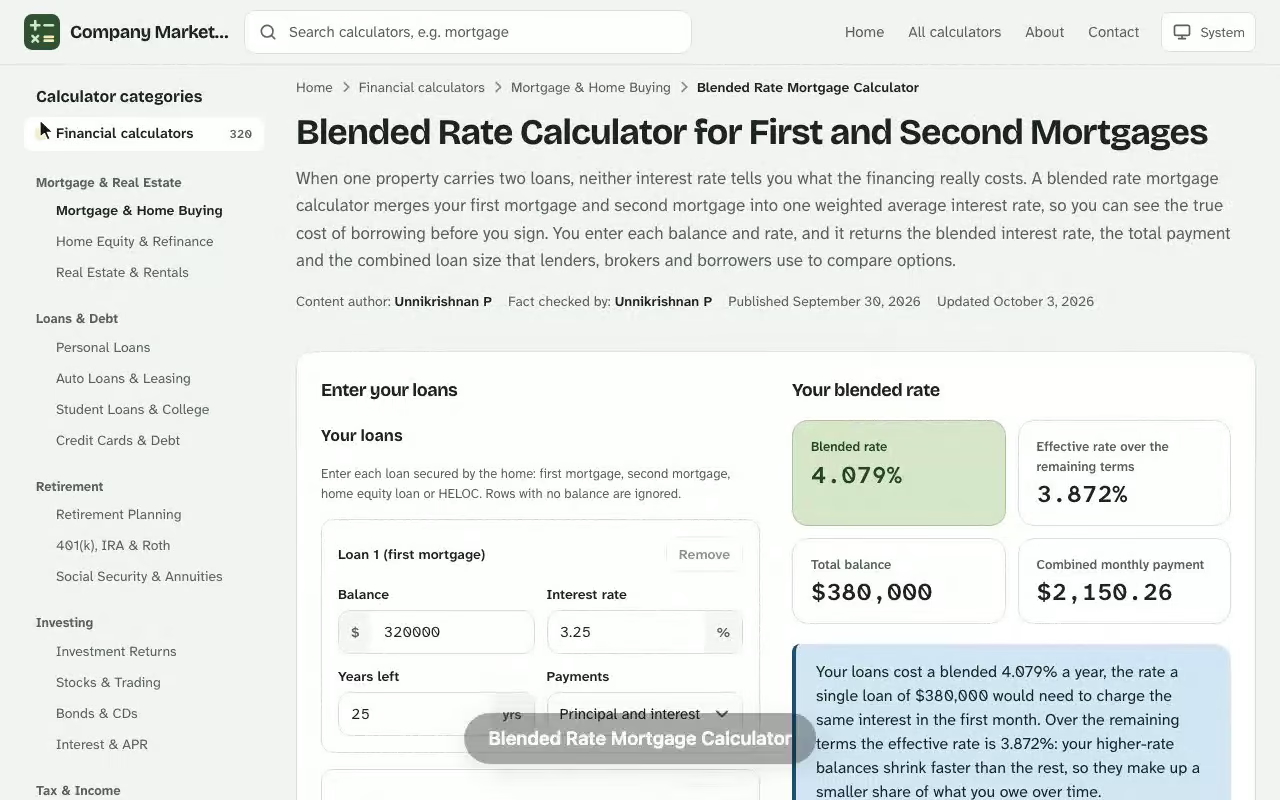
Blended Rate Mortgage Calculator. When one property carries two loans, neither interest rate tells you what the financing really costs. A blended rate mortgage calculator merges your first mortgage and second mortgage into one weighted average interest rate, so you can see the true cost of borrowing before you sign. You enter each balance and rate, and it returns the blended interest rate, the total payment and the combined loan size that lenders, brokers and borrowers use to compare options. The amortization calculator is free to use with no sign-up, and works on desktop and mobile.
Your blended rate
Blended rate
–
Effective rate over the remaining terms
–
Total balance
–
Combined monthly payment
–
–
Versus one new loan
Your loans
New loan
Set the new loan's rate and term under More options.
Each loan's share
The blended rate is each loan's rate weighted by its share of the total balance.
Loan
Balance
Share
Rate
Weighted rate
Monthly payment
Interest left
Results are estimates for educational purposes and are not financial, tax or legal advice.
What a Blended Rate Mortgage Calculator Tells You
A blended rate is an average interest rate that combines several debts into one consolidated rate. Each loan counts in proportion to its size: a large first mortgage at a low rate pulls the result down, while a small second mortgage at a higher rate nudges it up. The outcome always lands between your cheapest and your most expensive rate.
The idea comes up in a few situations, and the same arithmetic covers all of them:
Buying with two loans – homebuyers who put little or no money down often pair a first and second mortgage to reach close to 100% financing.
Tapping equity – homeowners keep a low-rate first mortgage and add a closed end second mortgage, which is popular with self-employed borrowers and real estate investors.
Blend and extend – a lender mixes your current mortgage rate with the rate on a new mortgage so you can raise funds or extend the term without early termination penalties.
Debt consolidation – you add several debts together to see whether one new loan would beat the average you pay now.
How the Blended Interest Rate Is Calculated
The method multiplies every balance by its own rate, adds those products, and divides by the sum of the outstanding balances. For two mortgages the formula is: If you want to see how the figures change, the fixed vs adjustable rate mortgage calculator gives you an instant result you can adjust as you go.
Here \(B\) is each loan's balance and \(r\) is its annual rate. Because it is a straightforward weighted average, the larger loan always has the larger say.
Enter your debts and balances
Gather the current balance, interest rate and loan terms for each loan, then type them into the blended rate calculator one row at a time. If you are comparing a purchase, use the amounts you plan to borrow instead. These debt balances should be the principal still owed today, not the original loan amounts. Leave out fees, since the blended figure only reflects interest rates and balances, and keep the term of each loan handy so the payment can be worked out afterward.
Monthly payment for each loan
The payment on every loan comes from the standard amortization formula, where \(P\) is the principal, \(i\) the monthly rate and \(n\) the number of payments:
$$M = P \times \frac{i}{1-(1+i)^{-n}}$$
Adding the two results gives your combined monthly payment. Note that a blended rate is only an exact stand-in for the pair when both loans run over the same term, so treat it as a guide, not a quote.
Worked Example: Blended Mortgage Calculator on Two Loans
Say you are buying a home valued at $412,000 with 20% down. You take a first mortgage of $247,200 at 6.12% over 30 years and a second mortgage of $82,400 at 8.45% over 15 years. That gives a total debt balance of $329,600, split 75% and 25% between the two loans.
Loan
Balance
Rate
Term
Monthly payment
Balance × rate
First mortgage
$247,200
6.12%
30 years
$1,501.21
1,512,864
Second mortgage
$82,400
8.45%
15 years
$809.01
696,280
Combined
$329,600
6.70%
–
$2,310.23
2,209,144
Dividing 2,209,144 by $329,600 gives a blended interest rate of 6.70%. Your total payment is $2,310.23 a month, and over the life of the loan you would pay $293,237 in interest on the first mortgage and $63,222 on the second, which is $356,459 of total interest if you hold both to maturity.
The 30-year first mortgage pays more in interest than principal, while the 15-year second mortgage pays mostly principal.
How changing one input moves the result
Because the first mortgage is large, the blended rate is more sensitive to the second mortgage's size than to its rate. The table shows what happens when you vary one input at a time.
Change
Second mortgage
Blended rate
Lower second rate
$82,400 at 7.25%
6.40%
Higher second rate
$82,400 at 9.65%
7.00%
Smaller second balance
$60,000 at 8.45%
6.58%
Larger second balance
$105,000 at 8.45%
6.81%
The blended rate climbs from 6.34% to 7.17% as the second mortgage grows and gets more expensive.
Reading Your Blended Rate Loan Calculator Results
A good blended rate loan calculator reports more than one number. Read them together rather than fixating on the headline percentage.
Blended interest rate – the single figure to compare against any offer to refinance.
Total payment – your combined monthly payments across both loans, which feed directly into your debt-to-income ratio.
Total debt balance – the combined amount owed, useful for checking against your property value.
Consolidation insights
The practical question is whether a single new loan would cost less. In the example, one 30-year loan of $329,600 at the 6.70% blend would cost about $2,127 a month, which is lower only because it stretches the second mortgage's balance over twice as long. That is why you should compare total interest, not just the monthly payment, before you consolidate.
Testing an 80/10/10 Purchase with the Blended Rate Calculator
Dario is buying a $538,500 townhouse with 10% down, $53,850. A single 90% loan means private mortgage insurance, so his lender offers an alternative: a first mortgage of $430,800, exactly 80% of the price, at 6.375% over 30 years, plus a $53,850 second mortgage at 9.15% over 15 years. The lender's single-loan quote is 6.875% with insurance added on top. Dario wants one number to compare, so he opens the blended rate calculator.
He types the first balance and rate, then the second, and the tool multiplies each balance by its rate, adds the two products and divides by $484,650. It returns a blended rate of 6.68% and a combined monthly payment of $3,238.63: $2,687.63 on the first mortgage and $551.00 on the second. The single loan at 6.875% would cost $3,183.81 before insurance.
That payment gap looks like a loss, but the comparison is not like for like. The 90% single loan carries mortgage insurance, and the two-loan structure keeps the first mortgage at the 80% loan-to-value line where lenders stop requiring it. The blended figure of 6.68% also sits 0.20 points under the 6.875% quote, so the interest cost of the pair is lower even though the 15-year second mortgage raises the monthly total.
The result gives Dario a specific next step. The 9.15% second mortgage is what lifts the blend above 6.375%, so he reruns the numbers with that rate changed to 8.65%, the figure a credit union quoted him. The blended rate falls to 6.63% and he asks his lender to match it before locking.
Blended Rate vs. Refinancing a Single Loan
Traditional refinancing replaces your current mortgage with a new mortgage at today's rate. If your existing rate is low, giving it up can be expensive, and breaking the contract may trigger penalties. A blend leaves the old balance at its old rate and mixes in the new money at the new rate, so the result sits somewhere between the two.
Some lenders pair this with extending mortgage terms, which lowers the payment but adds interest over time. Others let you add funds as a second mortgage instead. Either way, the cost of borrowing depends on the loan terms you accept, so check both the rate and the term.
Run the numbers on both routes before you commit: price the blend, price a full refinance, and put the monthly payment, the total interest and any penalty side by side. A difference of a quarter of a percentage point on a balance this size adds up to thousands of dollars across the term.
See how the Blended Rate Mortgage Calculator works: change the inputs and the blended rate updates instantly. Enter your own numbers in the calculator above.
Before you refinance, ask the lender for the fee schedule, the penalty for early termination and any change to your term, then add those costs to the figure the calculator gave you. A cheaper blended rate can still lose to a plain loan once costs are counted.
Who Uses a Weighted Average Interest Rate Check
Mortgage brokers and loan officers run the numbers to show clients what a two-loan structure costs. Financial advisors use the same insights for financial planning, since a clear view of what each borrower pays helps them rank which debt to pay off first. Homebuyers use it to compare a single large loan with first and second mortgages, while homeowners with equity use it to judge a home-equity add-on. A blended mortgage calculator suits all of them because it answers the same question in seconds: what is the one rate I am paying across everything I owe?
Whichever blended mortgage structure you are weighing, keep in mind that the figures are for estimation purposes only. Property taxes, insurance, HOA dues and your credit score all affect what a lender will actually offer, so confirm final terms with a licensed professional.
Blended Rate Mortgage Calculator questions
What is a blended rate on a mortgage?
A blended rate is the weighted average interest rate across all the loans on a property. Each rate counts in proportion to its balance, so the larger loan has the bigger say in the result.
How do you calculate the blended interest rate?
Multiply each loan's balance by its interest rate, add those products together, and divide by the total of the outstanding balances. This calculator does it for you from the amounts and rates you enter.
Is the blended rate the same as the rate on a single new loan?
Not exactly. The blended rate is a guide for comparison. It is only an exact stand-in when every loan is paid off over the same period, so check the monthly payment and total interest too.
Why would someone use a first and second mortgage?
Buyers with a smaller down payment may keep a first mortgage at a lower rate and add a second mortgage to reach the financing they need, and homeowners may add a second loan to tap equity without giving up their current first mortgage rate.
Does the calculator include taxes, insurance and HOA?
Your blended rate only reflects loan balances and interest rates. The optional monthly insurance, taxes and HOA fields are added to your total monthly payment so you can see a fuller housing cost.
What is combined LTV?
Combined loan-to-value is the total of all your loan balances divided by the property value. Lenders use it to judge how much of the home's value is borrowed against.
Can I blend more than two debts?
Yes. Add up to three more loans in the optional rows to see the blended rate across as many as five balances, for example when comparing a consolidation of several debts.