Biweekly Mortgage Payment Calculator for an Existing Mortgage
Biweekly Mortgage Payment Calculator for an Existing Mortgage. If you are already years into a home loan, the biweekly mortgage payment calculator for an existing mortgage shows exactly what happens when you switch to half payments: how many months disappear from your payoff date and how much interest stays in your pocket. Enter what you borrowed, your rate and the time you have left, click the Calculate button, and you can see whether the change could help you pay off your mortgage years early and save thousands of dollars. Next, open the amortization calculator and enter your own details to see an estimate in seconds.
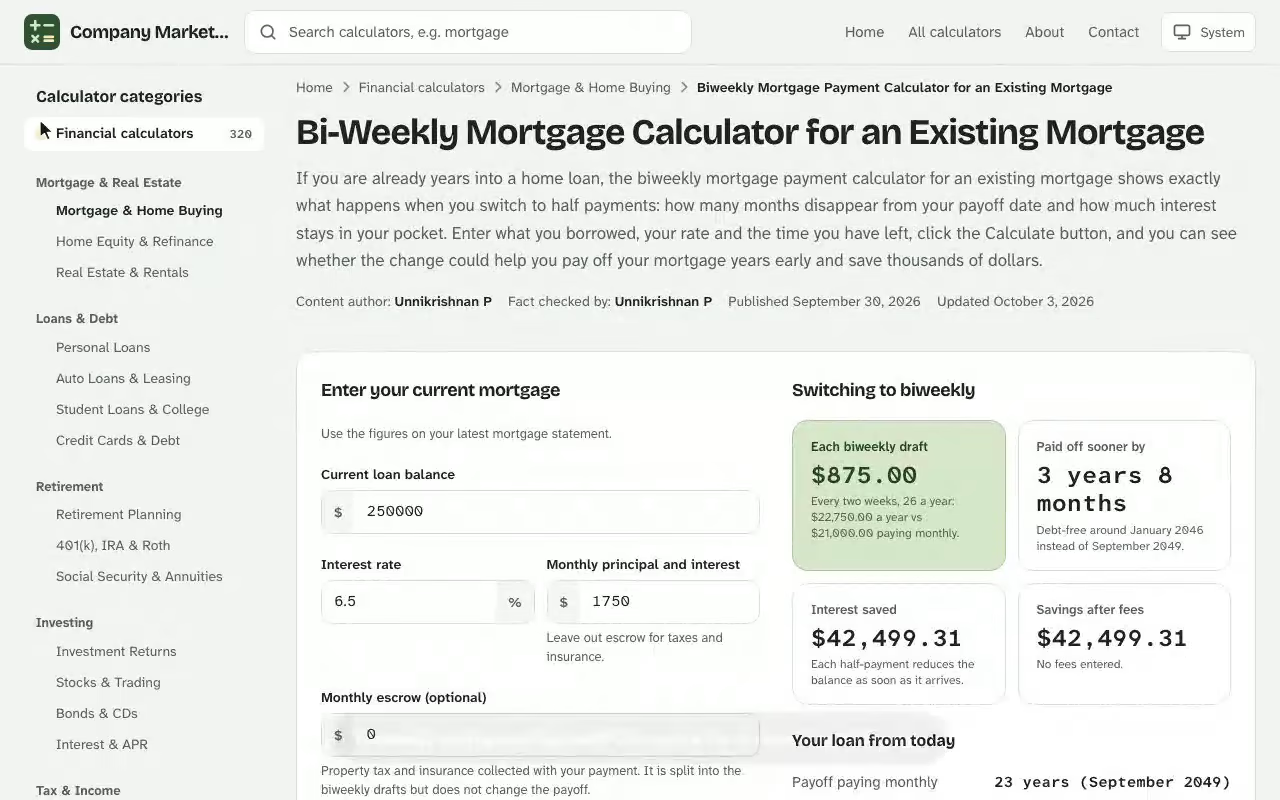
Switching to biweekly
Each biweekly draft
–
Paid off sooner by
–
Interest saved
–
Savings after fees
–
Your loan from today
Payoff paying monthly–
Payoff paying biweekly–
Interest left, monthly–
Interest left, biweekly–
Total biweekly fees–
Interest saved by adding 1/12 of a payment each month yourself–
You may not need a program
Year by year from today
Balance at the end of each year from now and the interest paid in that year, staying monthly versus switching to biweekly.
Year
Monthly: interest
Monthly: balance
Biweekly: interest
Biweekly: balance
Balance difference
Results are estimates for educational purposes and are not financial, tax or legal advice.
Biweekly Mortgage Payment Calculator for an Existing Mortgage: What You Enter
A tool built for a brand-new purchase only needs a price and a down payment. A free biweekly mortgage payment calculator like this one, or any bi-weekly mortgage calculator aimed at a loan that is already running, has to know where you stand today, so it asks for four things you can find on your closing paperwork and your latest statement. The apr calculator for adjustable rate mortgages uses the same plain-English approach, so you can compare results side by side.
Original loan amount: what you borrowed at closing, not what you owe now.
Original loan term: the length your note was written for, usually 15 or 30 years.
Interest rate: the fixed annual rate printed on your note.
Remaining loan term: the time left, entered in years and months.
From those four inputs the calculator rebuilds your schedule, works out today's balance and compares two futures: staying on one payment each month, or sending half of it every two weeks.
Original Loan Amount and Original Loan Term
These two values fix your regular monthly payment. Because the calculator re-creates your lender's schedule from the start, it needs the amount you borrowed originally, since a balance that has already shrunk would produce a different payment than the one you actually make. If your statement shows a payment that does not match the calculator's figure, the difference is usually taxes and insurance held in escrow, which sit outside the loan math.
Interest Rate and Remaining Loan Term
Type your note rate as a percentage. If you refinanced, use the new loan's figures rather than the first one. To find your remaining loan term, subtract the payments you have already made from the total number of payments, then divide by 12 months. A 30-year note has 360 payments, so a borrower who has made 74 of them has 286 left, which is 23 years and 10 months. Lenders sometimes call this number the payments remaining, and either way it tells the calculator how much runway is left for your extra payment to work on.
Reading Your Results
The output shows the payment you would send every other week, the total interest you would still pay, the new payoff time, the months you cut off and your interest savings compared with staying monthly. Treat the savings figure as an estimate for planning, because your lender's rounding and the date it posts each payment can move it slightly.
How Biweekly Mortgage Payments Work
With biweekly mortgage payments you pay half of your monthly bill every other week instead of one full payment once a month. A year has 52 weeks, so you make 26 payments of half your bill, and 26 halves equal 13 full ones. Your regular schedule has only 12 months, which means the plan quietly adds one extra monthly payment every year without any single payment feeling large. If you want to see how the figures change, the apr mortgage calculator online gives you an instant result you can adjust as you go.
That extra monthly payment goes straight at the loan balance. Interest is charged on what you owe, so each dollar of principal removed today stops generating interest for every remaining year of the loan. The saving compounds: the earlier balance reductions mean smaller interest charges, which leave more of each later payment for principal.
The Formula Behind the Biweekly Payment
First the calculator finds your regular payment M from the loan amount P, the monthly rate r (annual rate divided by 12) and the number of payments n:
$$M = P \times \frac{r(1+r)^{n}}{(1+r)^{n} - 1}$$
The biweekly figure is simply half of that, and interest is charged at one twenty-sixth of the annual rate each period:
$$B = \frac{M}{2} \qquad i = \frac{\text{annual rate}}{26}$$
Each period the balance grows by interest \(i\) and falls by \(B\), and the calculator repeats that until the balance reaches zero. Counting those periods gives your new payoff date.
Why Twice a Month Is Not the Same Thing
Paying half your bill on the 1st and the 15th feels similar, but a bi-weekly payment schedule is different: twice a month produces only 24 half payments, which equals 12 full ones and no acceleration. The schedule only works because 52 weeks divide into 26 pairs. If your lender offers a semi-monthly option, it will not cut your payoff time on its own.
Worked Example: Biweekly Payment Savings on an Existing Mortgage
To see the numbers, take a homeowner who borrowed $412,500 on a 30-year fixed loan at 6.35% and has made 74 payments. The regular monthly mortgage payment for principal and interest is $2,566.72. After 74 payments the loan balance is $377,836.05, and 286 payments remain. Splitting the monthly figure in two gives a biweekly payment of $1,283.36.
Monthly Payment vs Biweekly Payment Results
Result
Monthly payments
Biweekly payments
Payment amount
$2,566.72
$1,283.36
Payments per year
12
26
Paid out in one year
$30,800.67
$33,367.39
Remaining loan term
23 years and 10 months
About 20 years
Total interest from today
$356,246.52
$290,091.97
Interest savings
None
$66,154.55
The homeowner pays an extra $2,566.72 per year, exactly one more monthly payment, and gets back about three years and ten months along with $66,154.55 in interest costs. Over the first year, $9,666.67 of those payments reduce the debt instead of $7,009.76, which is why the balance starts to fall faster right away.
Year one on a $377,836.05 balance at 6.35%: the extra payment goes to principal.
Amortization Schedule Snapshot
A full amortization schedule lists every payment split into interest and principal. This five-year summary shows the principal balance still owed under each plan, measured from today.
Years from today
Balance, monthly plan
Balance, biweekly plan
5
$337,895
$322,745
10
$283,073
$247,096
15
$207,829
$143,219
20
$104,553
$579
The gap widens each year because interest is calculated on a smaller balance every time. By the twenty-year mark the biweekly plan has all but finished, while the monthly plan still owes more than $100,000.
The balance gap grows from about $15,000 at year 5 to over $100,000 at year 20.
Biweekly vs Monthly: How Payment Frequency Changes Your Payoff Timeline
Changing payment frequency does two separate things. It speeds up how often principal is reduced, so interest has less time to accrue between payments, and it adds one full payment a year. The second effect does most of the work: a rough check is to divide your regular payment by 12 and add that amount to every month's bill, which reproduces most of the savings without changing how you pay.
A realistic payoff timeline depends on three things you control. A higher rate makes the switch more valuable because more of each payment is interest. More time remaining makes it more valuable because the extra payment has more years to compound. A bigger share of the loan already paid makes it less valuable, since little interest is left to save.
Total interest still to pay drops by $66,155 with biweekly payments.
Whether yours is a 15-year or 30-year mortgage, the same logic holds: a mortgage with a higher rate and more years left rewards extra principal the most, and a mortgage close to its last payment rewards it least.
A newer loan at a high rate sees the largest interest savings.
A loan near its final years sees only a few months of difference.
A low rate loan may be better served by putting spare cash toward other goals.
Testing a Bi-Weekly Mortgage Calculator Against a Retirement Date
Priya is 44, paid every other Friday, and wants the house paid off before she turns 62, the earliest age she can claim Social Security. Her statement shows a 30-year fixed loan with an original balance of $318,750 at 5.875%, and her 118th payment just cleared. That leaves 242 payments, or 20 years and 2 months, which would end the loan at 64.
She enters $318,750, a 30-year original term, 5.875% and a remaining term of 20 years and 2 months, then clicks Calculate. The regular principal and interest payment comes back as $1,885.53 against a balance of $267,011.67, so her biweekly payment is $942.76. The results read:
Total interest on the monthly plan: $189,285.77
Total interest on the biweekly plan: $159,695.73
Payoff after 453 payments, which is 17 years and 5 months, instead of 20 years and 2 months
The difference in interest is $29,590.04, and the payoff lands at age 61 and a few months, ahead of her age-62 target by about half a year. She notices that the date is close, so before committing she reads her note, finds no prepayment clause, and phones the servicer to confirm each half payment posts to principal the day it arrives.
The answer to "can I do this on my paycheck schedule" is yes, so she sets up autopay for $942.76 every other Friday. She keeps the tool open and plans to rerun it each January with her new balance, because a raise that lets her round up by even $50 would move the finish date earlier still.
Are Bi-Weekly Mortgage Payments Right for You?
Faster payoff is not automatically the best use of money. Before you commit, run through a short checklist.
Is your paycheck biweekly? Matching each payment to a paycheck makes the budget easy. If you are paid monthly, an extra principal amount added to the monthly bill is simpler.
Do you have an emergency fund? Money sent to the lender is hard to get back. Build three to six months of expenses first.
Is high-interest debt hanging over you? A credit card charging 22% costs far more than a 6.35% mortgage, so pay that debt off first.
Could the money earn more elsewhere? If your rate is low, an investment or a retirement account match may beat the guaranteed return of paying down the loan, and other financial goals may deserve the money first.
How long will you stay in the home? Moving in a few years leaves little time for the savings to build, and anyone close to retirement should ask a financial adviser how the payoff fits the bigger plan.
Build Equity and Remove PMI Sooner
The faster balance drop in the biweekly results is what carries you to 80% of your home's value sooner. Extra principal helps you build equity faster, and on a conventional loan, once your balance reaches that 80% mark you can ask to cancel private mortgage insurance (PMI), which lowers your monthly cost. Faster equity also strengthens your position if you later refinance, but closing costs can offset the savings, so compare the figures first.
Fixed-Rate vs Adjustable-Rate Loans in This Calculator
The calculator assumes a fixed-rate loan, where the rate never moves. With an adjustable-rate loan the rate can change after the initial period, so rerun the numbers whenever your rate resets.
How to Set Up Biweekly Mortgage Payments With Your Lender
Start by calling your bank or loan servicer and asking whether it accepts biweekly payments. Some let you turn on autopay every two weeks in the online portal. Others hold each half payment until the full monthly amount is available, which removes the benefit, so ask exactly when each payment posts to your balance.
Beware of Third-Party Processors
Some companies offer to manage the schedule for you. Any third-party service that collects your money first and forwards it monthly delivers none of the acceleration, and many charge processing fees of several hundred dollars. You can reach the same result for free by paying your lender directly.
Check for a Prepayment Penalty
Read your note for a prepayment penalty, a fee some loans charge when you pay ahead of schedule. It usually applies only in the first few years, and it can cancel out the savings if it exists. Also confirm that every extra dollar is applied to principal and does not simply sit in escrow, the account that collects your property taxes and homeowners insurance.
Alternatives to Biweekly Mortgage Payments
If your lender does not allow biweekly payments, you can copy most of the benefit yourself.
See how the Biweekly Mortgage Payment Calculator for an Existing Mortgage works: change the inputs and the each biweekly draft updates instantly. Enter your own numbers in the calculator above.
Add one-twelfth of your payment to every monthly bill as an extra payment.
Make one lump-sum extra principal payment each year.
Send a windfall such as a bonus or a tax refund to the principal.
Round your payment up to the next hundred dollars.
Each option shortens your mortgage payoff and lowers interest costs, and you can try each one in the calculator before choosing.
What the Biweekly Calculator Includes and Leaves Out of Your Mortgage Payment
Most statements combine principal and interest with taxes, insurance and, where required, PMI. The results above leave those out, so the calculator covers only the loan itself, because escrow amounts change from year to year and are not shortened by an early payoff. Think of it as a mortgage on your home that costs more in interest at the start than at the end: early in the loan most of each payment is interest, and as you amortize, a larger share goes to principal. Knowing that split helps you see why a sooner start gives the biggest results and why the mortgage rate on your note is the single most important input.
Rerun the calculator after any change to your balance or rate, because the finance side of the result, meaning your finish date, cost and balance, shifts with your income and budget and gives you a clearer financial picture each time.
The Bottom Line on Paying Your Mortgage Every Two Weeks
Paying every other week lets you calculate a clear tradeoff: one extra monthly payment a year in return for a shorter loan and a lower interest bill. It works best on a high-rate loan with many years left, when your budget is steady and your lender applies each payment to principal at once. Run your own numbers in a biweekly mortgage calculator, then compare the result with other uses of your money before you decide.
Biweekly Mortgage Payment Calculator for an Existing Mortgage questions
How do biweekly mortgage payments save money?
You pay half your monthly payment every two weeks, which makes 26 half payments, or 13 full monthly payments, each year. The extra payment goes to principal, so less interest accrues and the loan ends sooner.
Is a biweekly payment the same as paying twice a month?
No. Twice a month is 24 half payments, the same as 12 monthly payments. Every two weeks is 26, which adds one full extra payment a year.
Will my lender accept biweekly payments?
Not all do. Ask your servicer whether it offers a biweekly plan, whether it charges a setup fee, and how each payment is applied. If it does not, add one-twelfth of your payment to each monthly bill.
Should I use a third-party company to set up biweekly payments?
Usually not. These services may charge fees and hold your money until the monthly due date, which removes the benefit. You can pay your lender directly for free.
Can a prepayment penalty cancel out the savings?
Yes. Some loans charge a fee for paying ahead of schedule, usually in the first few years. Check your note and compare the penalty with the interest savings the calculator shows.
Are biweekly payments worth it on a low-rate mortgage?
The savings shrink as your rate falls and as your loan nears its end. With a low rate, investing the extra money or building an emergency fund may be a better use of it.
Do the results include taxes and insurance?
No. The interest and payoff results use principal and interest only, because escrow amounts for property taxes and homeowners insurance are not part of the loan balance.