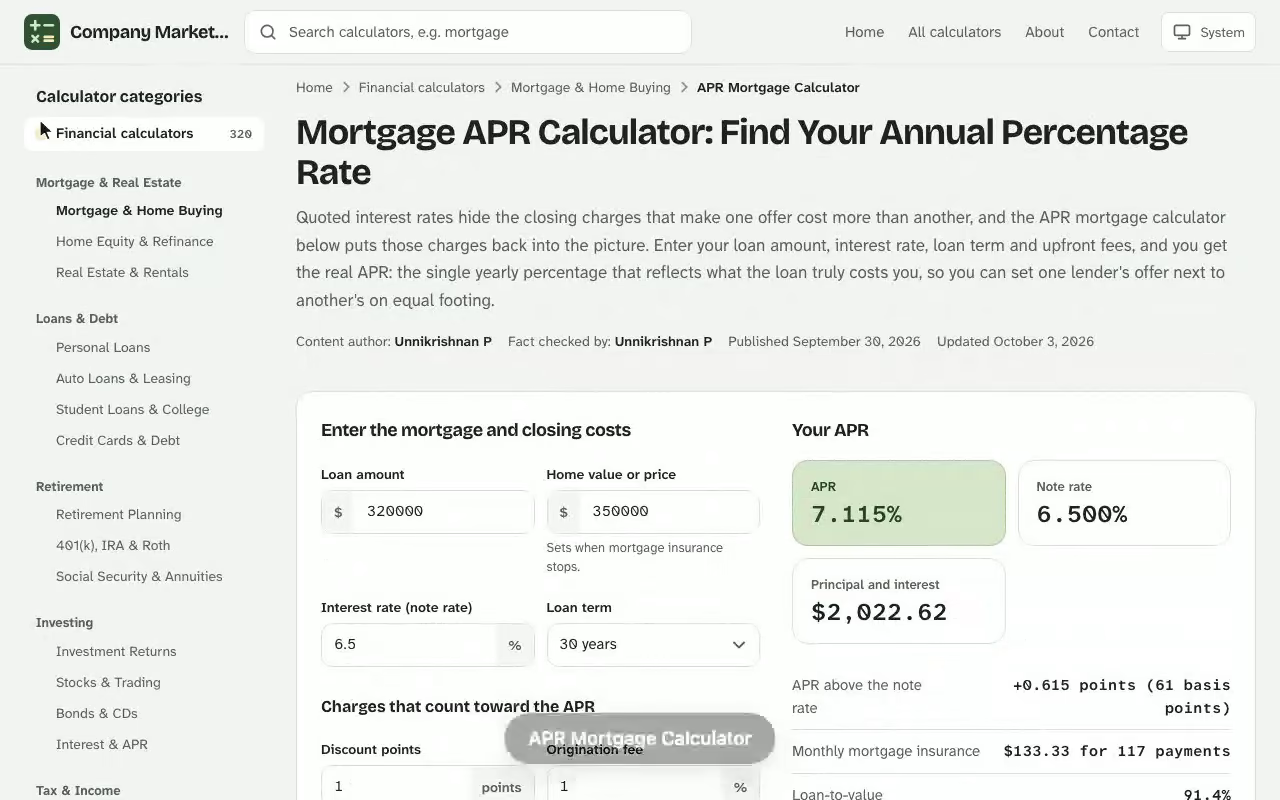
APR Mortgage Calculator. Quoted interest rates hide the closing charges that make one offer cost more than another, and the APR mortgage calculator below puts those charges back into the picture. Enter your loan amount, interest rate, loan term and upfront fees, and you get the real APR: the single yearly percentage that reflects what the loan truly costs you, so you can set one lender's offer next to another's on equal footing. The free amortization calculator is free to use with no sign-up, and works on desktop and mobile.
Your APR
APR
–
Note rate
–
Principal and interest
–
APR above the note rate–
Monthly mortgage insurance–
Loan-to-value–
Prepaid finance charges–
Amount financed–
Finance charge–
Total of payments–
Closing fees left out of the APR–
Accuracy allowed on a disclosure–
The APR is the yearly rate at which your payments, including mortgage insurance, repay exactly the amount financed: the loan minus the charges you pay up front.
What moves the APR above the note rate
Each line adds one group of charges to the one before, so you can see which costs widen the gap most.
Charges included
APR
Added by this step
Which fees are finance charges
Sorted under Regulation Z, 12 CFR 1026.4. Only finance charges feed the APR.
Fee
Amount
Finance charge?
Rule
Title, document, notary, credit report and appraisal fees stay out of the APR only if they are bona fide and reasonable. A third-party fee becomes a finance charge when the lender requires the service and keeps part of the fee, and closing-agent fees count when the lender requires that particular service or charge (12 CFR 1026.4(a)(1)–(2)). Your Loan Estimate shows the lender's own figure.
Results are estimates for educational purposes and are not financial, tax or legal advice.
How the APR Mortgage Calculator Works
Unlike a general APR calculator that stops at a fee total, this tool starts with the monthly payment your interest rate produces, then asks a different question: if the money you really receive is smaller than the loan amount because fees were deducted at closing, what yearly rate makes those same payments repay it? That answer is the APR. Because the payment stays the same while the usable cash shrinks, the APR is always higher than the note rate whenever you pay any upfront fees. Next, open the existing mortgage biweekly calculator online and enter your own details to see an estimate in seconds.
What You Enter
The inputs mirror what appears on a lender's quote. You supply four things, and the calculator does the rest:
Loan amount: the home price minus your down payment.
Interest rate: the stated yearly rate on the note, before any fees.
Loan term: the number of years you will repay, most often 15, 20 or 30.
Upfront fees: every finance charge you pay at closing, including points.
Which Fees Belong in the Calculation
Under the Truth in Lending Act, a lender must disclose an APR so that every borrower can compare offers. Not every closing charge counts toward it, so ask each lender which items it folded in. Charges that usually raise the APR are listed below, along with those that normally stay outside it.
Usually included in the APR
Usually left out of the APR
Origination points and discount points
Appraisal fees
Application fees and administration fees
Title insurance and survey fees
Underwriting fees and processing fees
Prepaid property taxes and homeowners insurance
Mortgage broker fees
Escrow deposits
Private mortgage insurance (PMI)
Credit report charges
Mortgage APR Calculator Formula and Worked Example
Two steps produce the answer. First, the monthly mortgage payment of principal and interest, with monthly rate \(i\) and \(n\) payments: If you want to see how the figures change, the mortgage debt consolidation calculator gives you an instant result you can adjust as you go.
$$M = P \times \frac{i}{1-(1+i)^{-n}}$$
Second, the APR is the monthly rate \(i_a\) that makes those payments worth only the amount financed, which is the loan minus fees \(F\), and then the result is multiplied by twelve:
$$P - F = M \times \frac{1-(1+i_a)^{-n}}{i_a}, \qquad \text{APR} = 12 \times i_a$$
There is no tidy closed form for \(i_a\), so the calculator searches for it numerically, which is why a tool is far easier than a pencil.
Our Sample Home Purchase
Say you buy a home for $465,000 and make a down payment of $69,750 (15%). That leaves a loan amount of $395,250 at a 6.25% interest rate over a 30-year term. The lender charges the upfront fees below, all paid in cash at closing:
Upfront charge
Amount
One discount point (1% of the loan)
$3,952.50
Origination fee
$1,895.00
Underwriting fee
$745.00
Processing fee
$1,189.00
Total finance charges
$7,781.50
The monthly payment of principal and interest is $2,433.62. Over 360 payments you repay $876,104.00, of which $480,854.00 is total interest. Since only $387,468.50 of cash actually reaches the seller after fees, the calculator reports a real APR of 6.439%, which is 0.189 percentage points above the note rate.
Reading Your Mortgage Loan APR Result
The gap between the note rate and the APR is the cost of the fees, expressed as a yearly rate. A small gap means the lender charges little beyond interest. A wide gap deserves a closer look at the fee list. As a rule of thumb, each additional $4,000 or so of fees on this sample loan adds roughly 0.1 percentage point to the APR, so you can see quickly how a fee change shifts the total cost.
Upfront fees on a $395,250 loan at 6.25%
APR
$0
6.250%
$3,000
6.322%
$7,781.50
6.439%
$12,000
6.544%
$16,000
6.646%
Annual Percentage Rate vs Interest Rate vs APY
People mix up these three figures constantly, and a lender's marketing rarely helps. The interest rate prices only the borrowed principal and sets your monthly payment. Your mortgage loan annual percentage rate folds in fees. The annual percentage yield (APY), also called the effective annual rate, adds the effect of compound interest and is what savings accounts and other deposit accounts advertise.
Why APR Looks Smaller Than APY
A mortgage APR is a monthly-period rate multiplied by twelve, so it ignores intra-year compounding. Converting your 6.25% rate to its yearly equivalent gives \((1 + 0.0625/12)^{12} - 1 \approx 6.43\%\). That is why a bank prefers to show APR on a loan, where the number looks lower, and APY on a savings account, where it looks higher. When you compare loans, compare APR with APR so the basis stays the same.
Fixed Rate and Variable Rate Loans
With a fixed-rate mortgage, the interest rate and therefore the payment stay constant, so the APR is a firm number. A variable rate works differently. An adjustable-rate mortgage starts low and then resets according to an index such as the federal funds rate or a market benchmark, with a credit-based margin added on top of it by the lender. This calculator computes a fixed-rate APR, so for an adjustable loan a variable APR built on the starting rate is only an estimate, not a promise. The longer the loan term, the more a rate swing can change what you really pay.
Comparing Two Lenders with the Mortgage APR Calculator
Marguerite Osei has a signed contract on a townhouse and two Loan Estimates on her desk, both for a $287,400 mortgage over 30 years. Lender X quotes 6.75% with $5,236 in upfront charges. Lender Y quotes 6.50%, but its charges total $9,118, because one discount point alone costs $2,874.
She enters X's figures first: loan amount 287,400, rate 6.75, term 30 years, fees 5,236. The calculator returns a monthly payment of $1,864.07 and an APR of 6.930%. Then she enters Y's figures: the payment drops to $1,816.56, while the APR reads 6.813%. Even with $3,882 more due at closing, Y's mortgage APR is 0.117 percentage points lower.
The APR alone does not settle it, because it assumes she keeps the loan for 30 years. So she divides the extra $3,882 by the $47.51 she saves each month and gets about 82 months, or roughly 6.8 years, to recover the added cost. Her employer's relocation window runs at least ten years, which clears that break-even point by more than three years. She asks Lender Y to confirm the figures in writing on a fresh Loan Estimate and locks the 6.50% offer, planning to rerun the numbers with a 7-year horizon only if the move date changes.
When the Total Annual Cost Is Misleading
APR spreads upfront fees across the entire loan term, which assumes you keep the mortgage until the final payment. Most people do not. A sale, a refinance or extra payments will end the loan early, and when that happens the fees look more expensive than the APR suggested because they are recovered over fewer years.
Discount Points and Your Break-Even Time
Take a second offer on the same home: a 5.875% rate with two points. Its upfront charges rise to $11,734.00, the monthly payment falls to $2,338.05, and the 30-year APR drops to 6.156%, so on paper it wins. Test the shorter horizon too. If you plan to sell and pay off the loan after 7 years, the APR for the first offer climbs to 6.618% and the second to 6.427%, so the lower rate still comes out ahead, but by a smaller margin. Keep paying points only if you expect to hold the loan past the time it takes to earn the extra cost back.
See how the APR Mortgage Calculator works: change the inputs and the result updates instantly. Enter your own numbers in the calculator above.
Offer one: 6.25% with one point and a $2,433.62 payment.
Offer two: 5.875% with two points and a $2,338.05 payment.
Costs the APR Does Not Capture
The APR this calculator returns covers only finance charges, so it is not a full budget. It omits property taxes, homeowners insurance and any HOA dues, none of which are part of principal and interest. If your down payment is under 20%, private mortgage insurance (PMI) is added to what you owe monthly, and you can usually request its removal once your equity reaches 20%. Price these separately before you decide what you can afford.
How to Calculate Your Mortgage APR and Compare Lenders
The fastest route is to gather the same figures from every lender, calculate each APR the same way, and compare the results in one list. A lender's Loan Estimate is the document to use, since every bank must provide it in the same layout.
Steps to Compare Two Mortgage Offers
Request a Loan Estimate from each lender on the same day and for the same loan amount.
Copy the interest rate, the loan term and every item in the origination and services sections.
Add up upfront fees, including discount points and any mortgage broker fees.
Run each offer through the calculator and note the real APR next to the monthly payment.
Check the total cost over the time you expect to keep the loan, not only the 30-year figure.
Loan Types That Change the Math
The loan type you choose affects both fees and APR. A conventional loan with a small down payment adds mortgage insurance. FHA loans carry their own insurance premiums, while VA loans charge a funding fee and USDA loans charge a guarantee fee, and each of these sits inside the APR for that loan type. A first-time homebuyer who qualifies for down payment help should recalculate, because a smaller balance lowers both the payment and the fees.
Ways to Lower Your Mortgage Loan APR
You have more control over your APR than over market mortgage rates. A few moves reliably trim the figure, and the calculator shows the effect of each before you commit:
Negotiate lender charges: origination and processing fees are often adjustable, and asking one lender to match another's quote can remove hundreds.
Improve your credit: a higher credit score can reduce both the rate and the fees, which compounds into a lower APR.
Raise your down payment: a bigger share paid in cash shrinks the loan and may eliminate PMI.
Choose a shorter loan term: a 15-year loan usually carries a lower note rate, and therefore a lower APR, while spreading the same fees over fewer years.
Buy points only with a long horizon: discount points pay off over time, not right away.
Refinancing, Prepaying and the APR
If you are refinancing, the refinance fees count as upfront charges, so run the numbers for the new loan the same way. Once you own the home, extra payments build your home equity faster, and you can prepay principal with extra payments, which cuts interest and shortens the payoff date, though it does not change the APR already disclosed on the original loan. A mortgage insurance removal request or a drop in mortgage rates are both reasons to run the calculation again.
Fees That Move the Total Annual Cost of Your Loan
Several charges are easy to miss on the first read of a quote, and each one either belongs in the calculator's upfront fees field or does not. Enter administration fees, application fees and any escrow fees a lender calls a finance charge, because they raise the APR. Leave out appraisal fees, survey fees and title insurance when the quote lists them as third-party costs, since they usually sit outside the disclosed figure. Treat any out-of-pocket fees you pay at closing as upfront charges, and ask each lender for an itemized list so the same cost is not counted twice, or missed, when you compare.
Rerun your calculation on every fresh Loan Estimate before you lock, because quotes shift with the market and the Federal Reserve's moves can change them within days. Pair the result with your closing costs, escrow deposits and expected holding period, and an amortization schedule (also called an amortization table) will show how each payment splits between principal and your origination points and interest. Higher inflation is one reason lenders reprice, which is why a fresh APR beats an old one.
APR Mortgage Calculator questions
What is a mortgage APR?
The mortgage APR, or annual percentage rate, is the yearly cost of your loan once interest and certain upfront finance charges are combined. It lets you compare offers that have different rates and fees on the same basis.
Why is my APR higher than my interest rate?
Fees and points reduce the cash you actually receive while your payment stays the same. The rate that makes those payments repay the smaller amount is higher than the note rate, so the APR sits above it whenever you pay upfront charges.
Which fees go into the APR?
Points, origination, application, underwriting, processing and mortgage broker fees, plus mortgage insurance, normally count. Appraisal, survey and title charges, prepaid taxes and escrow deposits are usually left out, so ask each lender for an itemized list.
Does a lower APR always mean a cheaper loan?
Not always. APR spreads upfront fees over the full loan term, so if you sell or refinance early those fees cost more per year than the APR suggests. Compare the monthly payment and your expected holding period as well.
How do discount points change the APR?
Each point costs 1% of the loan and usually lowers the interest rate. The points raise your upfront fees, so enter them in the Points field and compare the resulting APR with a no-points offer.
What is the difference between APR and APY?
APR for a loan uses a monthly period and ignores compounding within the year, while APY includes compounding and is mainly quoted for savings and deposit accounts. At the same rate the APY is higher than the APR.
How does this calculator treat PMI?
The yearly PMI amount you enter is added to each monthly payment while your balance is above 80% of the house value, and those payments are included in the APR calculation.
Is the APR the same for adjustable-rate mortgages?
This calculator assumes a fixed rate for the whole term. For an adjustable-rate mortgage the result is an estimate based on the starting rate, because later rate changes are unknown.