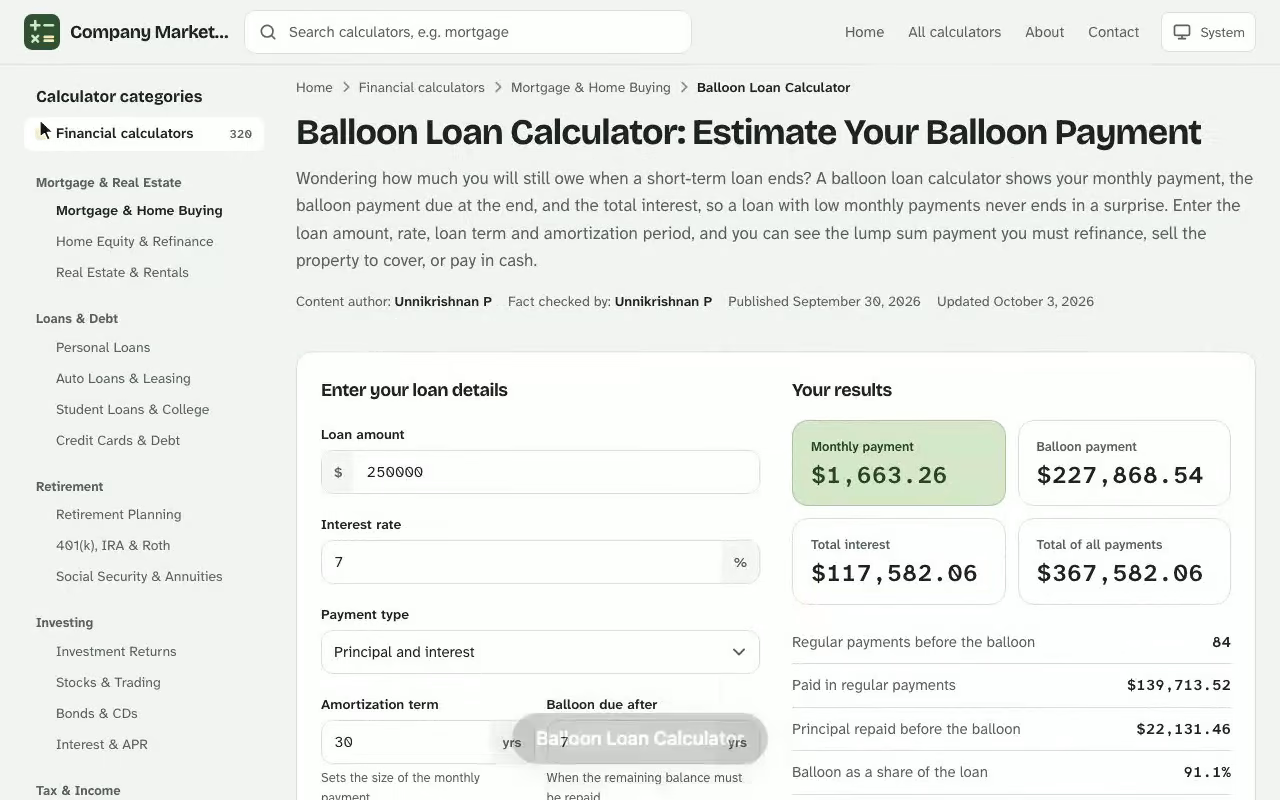
Balloon Loan Calculator. Wondering how much you will still owe when a short-term loan ends? A balloon loan calculator shows your monthly payment, the balloon payment due at the end, and the total interest, so a loan with low monthly payments never ends in a surprise. Enter the loan amount, rate, loan term and amortization period, and you can see the lump sum payment you must refinance, sell the property to cover, or pay in cash. The free amortization calculator uses the same plain-English approach, so you can compare results side by side.
Your results
Monthly payment
–
Balloon payment
–
Total interest
–
Total of all payments
–
Regular payments before the balloon–
Paid in regular payments–
Principal repaid before the balloon–
Balloon as a share of the loan–
The balloon is the balance left after the last regular payment. Most borrowers refinance or sell before it falls due, so plan for the rate you might get then.
Payment schedule
Regular payments up to the balloon date, then the balloon itself.
Year
Principal
Interest
Total paid
Ending balance
Results are estimates for educational purposes and are not financial, tax or legal advice.
How a Balloon Loan Works
A balloon loan is a short term loan whose monthly payments are calculated as if the debt would be repaid over a much longer period. Because the payment schedule stretches over, say, 20 or 30 years while the loan itself lasts only 5 or 7, the loan does not fully amortize, and most of the principal is still outstanding when the term ends. That unpaid amount is the balloon payment, and it is due in one piece. Next, open the 20 vs 30 year mortgage calculator and enter your own details to see an estimate in seconds.
Lenders offer this structure because it keeps each installment affordable while limiting how long they carry the risk. Borrowers usually accept it because they expect to refinance, sell, or receive money before the final due date. Many borrowers who choose a balloon mortgage do so for exactly that reason. The balloon mortgage is the best-known version, but the same design appears in car loans, bridge loans, and commercial real estate financing.
Loan Term vs. Amortization Period
Two different clocks run on every balloon loan. The loan term (also called the balloon period) is how long the loan actually lasts. The amortization period is the number of years used to calculate the monthly payment. A 5-year term with a 25-year schedule means you make 60 payments sized for a 300-payment loan, then owe whatever balance is left. This spread is called the loan amortization period in many lender disclosures.
Term: the date the whole remaining balance comes due.
Amortization: the schedule used to size each installment; a longer one lowers it but raises the balloon.
Rate: the yearly figure, divided by 12 for each monthly accrual.
Balloon Payment Calculator Formula
The monthly payment comes from the standard amortization formula, applied to the full schedule rather than the shorter term: If you want to see how the figures change, the fixed vs interest-only mortgage calculator gives you an instant result you can adjust as you go.
$$M = P \times \frac{i\,(1+i)^{n}}{(1+i)^{n}-1}$$
Here M is the installment, P is the loan amount, i is the monthly rate (annual rate ÷ 12) and n is the number of payments in the schedule. The balloon payment is the remaining balance after k payments, where k is the number of months in the loan term:
$$B = P\,(1+i)^{k} - M \times \frac{(1+i)^{k}-1}{i}$$
Total interest cost over the term equals the sum of all installments plus the balloon, minus the original loan amount: \(\text{Interest} = (M \times k) + B - P\).
Interest-Only Payments
Some lenders, especially on commercial mortgage deals, allow interest-only payments during the term. The installment is simply \(P \times i\), no principal is repaid, and the balloon equals the full loan amount. It is the lowest possible outlay, and also the largest balloon.
Balloon Loan Calculator Example
Suppose you take a $265,000 loan at 6.75% with a 5-year term and a 20-year amortization period. The calculation produces the figures below.
Item
Result
Loan amount
$265,000.00
Interest rate
6.75%
Loan term / schedule
5 years / 20 years
Monthly payment (principal and interest)
$2,014.96
Total payments over 60 months
$120,897.88
Balloon payment due at month 60
$227,702.91
Total interest cost
$83,600.79
Only about 14% of the original principal ($37,297.09) is repaid in five years. If you had chosen interest-only payments instead, your monthly payment would drop to $1,490.63, the total interest would be $89,437.50, and the balloon payment would be the full $265,000.
After 60 payments, only $37,297 of the $265,000 principal is repaid, leaving a $227,702.91 balloon payment.
Remaining Balance Year by Year
The amortization schedule shows why the early years barely dent the debt. In the first year alone, about $17,689 of your payments goes to interest and only $6,490 to principal.
Year-end
Remaining balance
Year 1
$258,509.57
Year 2
$251,567.22
Year 3
$244,141.49
Year 4
$236,198.72
Year 5 (balloon)
$227,702.91
How Amortization Changes the Balloon Mortgage
The length of the schedule is the lever with the biggest effect on a balloon mortgage. Using the same $265,000 loan at 6.75% and a 5-year term, the table compares four lengths, including the 30-year amortization that is typical of a fixed-rate mortgage.
Schedule length
Monthly payment
Balloon payment
Total interest
15 years
$2,345.01
$204,226.27
$79,926.88
20 years
$2,014.96
$227,702.91
$83,600.79
25 years
$1,830.92
$240,794.61
$85,649.54
30 years
$1,718.78
$248,770.63
$86,897.73
Moving from a 15-year to a 30-year schedule cuts the installment by $626.23 a month, but the large payment due at the end grows by $44,544.36. That trade-off is the core of every balloon decision: you borrow breathing room in the monthly budget and pay for it with a bigger bill later.
Balloon payment on a $265,000 loan by interest rate and amortization period; the worked example is outlined.
Interest Rate Sensitivity
The rate matters less to the installment than the schedule length does, but it still moves the balloon. On a 20-year schedule, a rate of 5.75% gives $1,861 a month and a balloon of $224,048, while 7.75% gives $2,176 and $231,124. A one-point change shifts the monthly cost by roughly $160, yet the balloon moves by only about $3,500, because most of the balance survives the short term either way. Check current mortgage rates for your credit profile before you model a scenario, since quoted rates differ widely between a bank, a credit union and a private lender.
How to Use This Balloon Payment Calculator
Follow these steps to model your own loan:
See how the Balloon Loan Calculator works: change the inputs and the monthly payment updates instantly. Enter your own numbers in the calculator above.
Enter the loan amount, the original balance you expect to borrow.
Enter the annual interest rate or APR quoted by the lender.
Set the loan term, the number of years until the balloon is due.
Set the amortization period used to size each installment.
Read the result fields, then print the report or review the amortization schedule.
Balloon Versus a 5-Year Fully Amortizing Loan
To see what the lower installment is worth, compare the example with a conventional 5-year loan for the same $265,000 at 6.75%. The conventional version costs $5,216.12 a month, which is $3,201.16 more than the balloon version, but nothing is owed at the end and total interest falls to $47,967.02. The balloon saves roughly $3,200 every month for five years and costs about $35,634 more in interest, and it leaves you holding the unpaid balance.
The balloon loan costs $348,601 in total cash versus $312,967 for a conventional 5-year loan.
Running a Bakery Building Purchase Through a Balloon Payment Calculator
Marisol Quintero is buying the storefront her bakery has rented for nine years. The seller's bank offers a $412,750 loan at 7.25% with a 7-year term, sized on a 30-year schedule. Before signing, she wants to know what the lender will expect on the last day and whether the bakery can carry it.
She enters 412,750 as the loan amount, 7.25 as the rate, 7 years as the term and 30 years as the amortization. The balloon payment calculator returns these figures:
Result
Value
Monthly payment
$2,815.68
Total of 84 payments
$236,517.34
Balloon due in month 84
$377,650.63
Interest paid over the term
$201,417.97
Her annual debt service is $33,788.18. The bakery's net operating income is $48,900, so the debt service coverage ratio is 1.45, comfortably above the 1.25 minimum her lender states. That clears the monthly test. The balloon is the real question: $377,650.63 is about 91.5% of what she borrowed.
She reruns the numbers for the exit. A new 25-year loan on $377,650.63 at 6.50% would cost $2,549.92 a month, and at 7.25% it would cost $2,729.68. Both are below today's installment, so the refinance passes at either rate, provided the building appraises above that balance. Her next step is concrete: she asks the lender for a written 90-day notice on the due date, and she schedules a refinance pre-application in month 72, twelve months ahead, rather than waiting for the last quarter.
Planning for the Balloon Payment
This type of financing is only as safe as your plan for the final payment. Lenders do not automatically convert the remaining balance into a traditional loan when the term is over, so you need one of three exits ready well before the due date.
Refinancing the Balloon Loan
Refinancing replaces the balance with a new, fully amortizing mortgage. On the $227,702.91 balloon from the example, a 20-year refinance at 5.75% would cost $1,598.66 a month, at 6.75% it would be $1,731.37, and at 7.75% it would be $1,869.32. Your ability to qualify depends on your credit, income, and the property's value at the time, not on what you qualified for originally.
Selling the Property
If you plan to sell the property before the term ends, compare the balloon payment the calculator shows with your expected net sale proceeds after closing costs. If the proceeds fall short, the sale will not clear the debt, which is why balloon financing suits short, predictable plans.
Paying the Lump Sum in Cash
Some borrowers save toward the lump sum payment instead. On the $227,702.91 balloon from the example, that means about $3,795 a month for 60 months in a sinking fund, set aside in your budget from day one rather than hoped for later.
If You Cannot Make the Balloon Payment
The balloon figure the calculator shows is the amount that triggers default if it is unpaid on the due date, and the lender may begin foreclosure or repossession. Talk to your lender at least six months before the due date about an extension or a refinance, because most are more flexible before a missed deadline than after.
Types of Loans With a Balloon Payment
Commercial Mortgages
A commercial mortgage on commercial real estate, such as an office, a warehouse or a retail unit, frequently has a 5- to 10-year term with a 25- or 30-year amortization. Bridge loans and hard money loans are shorter, often 1 to 3 years, and typically interest-only, with higher rates to match their risk. Agency programs from Fannie Mae and Freddie Mac also finance multifamily mortgage loans with balloon structures, and many commercial borrowers refinance with another commercial lender when the term ends.
Residential Mortgages
Residential mortgages with balloons usually run 5 to 7 years and are offered by credit union and community bank lenders that hold the loan on their own books. Since Regulation Z under the Truth in Lending Act requires lenders to confirm your ability-to-repay, a balloon mortgage still needs documented income, even though the monthly payment is small.
Car Loans
Some auto financing uses a balloon so the monthly payments stay low, leaving a residual payment at the end that you can pay, refinance, or settle by returning or trading in the vehicle.
Balloon Mortgage Rates and Qualifying
Mortgage rates on a balloon structure are often a little lower than on a 30-year fixed-rate loan, since the lender is exposed for fewer years. Rates still vary by lender type: a credit union may price a residential mortgage differently than a regional bank, and private lenders charge far more on hard money loans. Compare the APR rather than the headline rate so that points and fees are included. Type the quoted rate or APR into the calculator's rate field and the balloon updates immediately, so test the quote for your exact term: the rates shown for a 7-year balloon are not the same as those for a 3-year one.
Qualifying matters because the balloon the calculator returns is what you must refinance. A commercial mortgage underwriter looks at the property's income, while a residential mortgage lender focuses on income, credit and debt, and many lenders also test whether you could realistically refinance when the balloon comes due.
Pros and Cons of a Balloon Mortgage
Lower monthly payment: sizing payments to a long schedule frees up cash flow.
Short-term savings: useful if you will sell or refinance soon, since you rarely benefit from paying down principal slowly.
Refinancing risk: rates, credit, or property values may be worse when the balloon comes due, and borrowers who cannot refinance may face a forced sale.
Little equity growth: principal payments are small in the early years, so the debt stays high.
Payment shock: the final bill can be many times your monthly payment.
A balloon loan fits you if your income is expected to rise, your holding period is short, or you can pay the lump sum from a known source. It is a poor fit if you need predictable long-term financing and cannot absorb the refinancing risk. Before committing, compare the loan against a plain fixed-rate mortgage using the same inputs.
Balloon Loan Calculator Questions About Costs
Does the Calculator Include Taxes and Fees?
No. The figures cover principal and interest only. Because the balloon payment is principal, taxes and insurance do not change it, and an origination fee can be rolled in by raising the loan amount. Add property taxes, insurance and closing costs to your own budget when you compare offers.
Why Is My Total Interest So High Relative to Principal Repaid?
Interest accrues on the full outstanding balance, which barely falls in the early years. That is why the $120,897.88 paid in the example repays only $37,297.09 of the loan.
Balloon Loan Calculator questions
What is a balloon loan?
A balloon loan is a short-term loan whose monthly payments are calculated over a longer amortization schedule. Because the payments do not fully repay the debt, the remaining balance comes due as one large balloon payment when the term ends.
How is a balloon payment calculated?
Take the loan balance after the payments you have made. The calculator applies the standard amortization formula to the full schedule, then finds what is still owed at the end of the loan term. That remaining balance is the balloon payment.
What is the difference between the loan term and the amortization period?
The loan term is how long the loan actually lasts before the balloon is due. The amortization period is the number of years used to size each monthly payment. A longer amortization lowers the payment but increases the balloon.
What happens if I cannot make the balloon payment?
Balloon loans do not convert automatically into regular loans. You would need to refinance the balance, sell the asset, or pay it from savings. Missing it can lead to default, so talk to your lender well before the due date.
Can I enter a balloon amount instead of an amortization schedule?
Yes. Set the amortization schedule to 0 and enter the balloon amount your lender quoted. The calculator then solves for the monthly payment that leaves exactly that balance at the end of the term.
Are balloon payments only used for mortgages?
No. Balloon structures also appear in commercial real estate loans, bridge loans, and some car loans. Residential balloon mortgages typically run 5 to 7 years, while bridge and hard money loans are often shorter.
How does the origination fee affect the results?
A fee can be paid upfront or added to the loan. Adding it increases the amount financed, which raises the monthly payment, total interest and balloon. Paying it upfront shows up in the Paid Upfront result.
Does this calculator include taxes and insurance?
No. The results cover principal and interest, plus any origination fee you enter. Property taxes, insurance and other closing costs are not included, so add them to your budget separately.