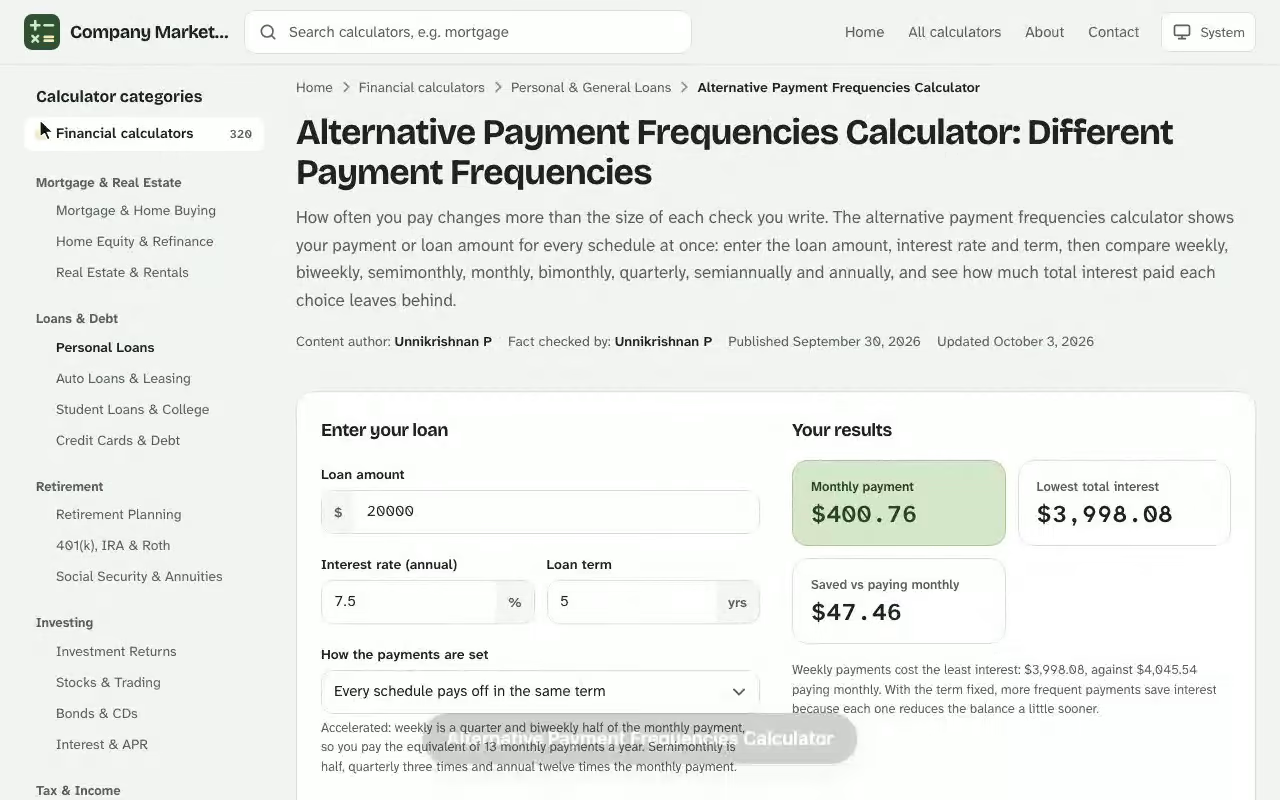
Alternative Payment Frequencies Calculator. How often you pay changes more than the size of each check you write. The alternative payment frequencies calculator shows your payment or loan amount for every schedule at once: enter the loan amount, interest rate and term, then compare weekly, biweekly, semimonthly, monthly, bimonthly, quarterly, semiannually and annually, and see how much total interest paid each choice leaves behind. Pair this with the payment calculator for a fuller picture before you make a decision.
Your results
Monthly payment
–
Lowest total interest
–
Saved vs paying monthly
–
–
Every payment frequency side by side
The same loan, rate and term, paid on six different schedules.
Frequency
Payment
Paid per year
Number of payments
Paid off in
Total interest
vs monthly
Balance at the end of each year
How fast each schedule brings the balance down.
Results are estimates for educational purposes and are not financial, tax or legal advice.
How the Alternative Payment Frequencies Calculator Works
A payment frequency is simply the number of times per year you send money to your lender. A payment frequency calculator converts your annual interest rate into a periodic rate for that schedule, spreads the loan term across the matching number of periods, and solves for the installment. It then rebuilds the amortization schedule so you can see principal balances after every payment. The 365 365 loan calculator online uses the same plain-English approach, so you can compare results side by side.
See how the Alternative Payment Frequencies Calculator works: change the inputs and the monthly payment updates instantly. Enter your own numbers in the calculator above.
Inputs: Loan Amount, Interest Rate and Loan Term
Three numbers drive everything. The loan amount is what you borrow, the interest rate is the annual rate on the note, and the term is how many years you have to repay. Add a payment frequency and the calculator has all it needs to size your installments.
Results: Total Interest Paid and Principal Balances
Every frequency returns the same set of outputs: the periodic payment, the total of all payments, the total interest paid over the life of the debt, and the balance remaining after each period. Reading principal balances down the schedule shows how quickly the debt shrinks under each plan.
Payment Frequencies Explained: Weekly, Biweekly, Semimonthly and Monthly
Lenders spell the options differently, so you will see bi-weekly, semi-monthly, bi-monthly and semi-annually in different places. The table below pins down what each one means and how many installments it creates per year. If you want to see how the figures change, the loan prequalification calculator gives you an instant result you can adjust as you go.
Frequency
Payments per year
Typical use
Weekly
52
Paychecks that arrive every week
Biweekly
26
Paychecks every other week
Semimonthly
24
Paid on the 1st and 15th
Monthly
12
Standard mortgage loan and auto loan schedule
Bimonthly
6
Every two months
Quarterly
4
Business and farm lending
Semiannually
2
Twice a year
Annually
1
Once a year
The Payment Formula Behind Different Payment Frequencies
Every fixed installment loans schedule uses the same level-payment equation. Only the periodic rate and the number of periods change when you pick another frequency:
$$\text{Payment} = P \times \frac{r}{1-(1+r)^{-n}}$$
Here \(P\) is the loan amount, \(r\) is the annual rate divided by payments per year, and \(n\) is the term in years multiplied by payments per year. Because interest accrues on a balance that is reduced more often, shorter periods nudge the periodic payments and the interest total down, but only slightly unless you also pay more.
Worked Example: Comparing Payment Schedules on a $284,500 Loan
Take a $284,500 loan at 6.35% over 25 years. Running each of the payment schedules through the formula gives these results:
Frequency
Payment
Payments made
Total interest paid
Annually
$23,001.00
25
$290,525.07
Semiannually
$11,427.43
50
$286,871.46
Quarterly
$5,695.39
100
$285,038.96
Bimonthly
$3,792.85
150
$284,427.28
Monthly
$1,894.38
300
$283,815.18
Semimonthly
$946.68
600
$283,508.96
Biweekly
$873.82
650
$283,485.40
Weekly
$436.80
1,300
$283,344.04
Monthly Payment Versus Weekly Payment
Moving from a monthly payment of $1,894.38 to weekly installments of $436.80 trims only about $471 from the interest bill across 25 years. The gap between annual and monthly is far larger, roughly $6,710, because a full year passes before the balance ever drops. Switching frequency alone is a modest lever; what you do with the schedule is the bigger one.
Bi-Weekly Payment Schedule: Paying Every Other Week to Save Money on Interest
The real gain comes from a bi-weekly payment schedule built on half of the monthly installment. Pay $947.19, which is half of $1,894.38, every other week and you make 26 payments a year, equal to 13 monthly payments. That is one extra payment toward principal each year, and it is why many borrowers describe bi-weekly mortgage payments as a way to accelerate mortgage payoff.
Accelerate Mortgage Payoff With Extra Payments
On the example loan, the half-payment plan retires the debt in about 20.9 years instead of 25, and total interest falls from $283,815 to about $229,090. That is roughly $54,725 of interest savings and just over four years of early payoff. The same effect comes from any set of extra payments applied to principal, so you can test a one-time lump sum the same way.
Confirm that your lender applies each biweekly amount to principal as it arrives, rather than holding it until a full monthly payment accumulates.
Ask whether setting up automatic withdrawals carries a fee.
Check that the lender does not charge a penalty when you pay off your loan ahead of schedule.
Switching Payment Schedules: A Homeowner Tests a $162,300 Balance
Dario's statement shows a $162,300 balance at 5.85% with 18 years left, and a note that stopped penalizing prepayment after its 36th month, which passed last spring. He is paid every other Friday, so he opens the calculator to see whether matching his debit to his paycheck is worth the paperwork.
He enters the three loan figures and checks the monthly baseline first. It returns $1,216.84, which agrees with his statement to the cent, and total interest of $100,538. Then he selects biweekly and sets the payment to half the monthly amount, $608.42, because that is what his lender's autopay would draft.
Payments made: 408, ending after 15.7 years instead of 18
Total interest: $85,888, which is $14,650 less than the monthly plan
Extra cash per year: $1,216.84 × 1 = one added monthly payment, spread across 26 drafts
Before committing, he reruns the comparison with weekly installments of $304.21. The payment frequency change saves only another $139 in interest, so the added drafts are not worth it. His next step is concrete: he calls the lender to confirm each biweekly draft posts to principal on the day it arrives, then schedules the first one for the Friday after his next paycheck.
Payment Frequency Calculator Settings: Choosing the Right Option
With any alternative payment frequency calculator, match the schedule to your income first and the math second. If your employer pays you every other week, a biweekly debit keeps the loan in step with your cash flow and avoids a large monthly hit. If your income is irregular, a quarterly or monthly plan with room to add extra payments may be safer than committing to dozens of small installments.
Keep in mind how the product works as well. A mortgage loan or home equity loan usually follows the monthly mortgage payments convention, while a credit line or a balloon loan may allow other schedules. Commercial notes often use daily interest, which changes the numbers slightly, and a larger down payment shrinks the amount you need to borrow, which lowers every installment on the page.
Using an Extra Payment Calculator and Loan Calculator Together
A general loan calculator shows the base payment, while an extra payment calculator shows what added money does to the payoff date. Use both when you are trying to pay down debt faster, consider a refinance, or run a loan comparison between lenders. Calculators with slider controls give real-time results, which makes it easy to see how a lower rate or a shorter term changes the balance and the savings.
Enter your loan amount, interest rate and term in years.
Select the payment schedule you want to test.
Read the payment, the number of payments made and the total interest.
Repeat with a different schedule and compare the totals side by side.