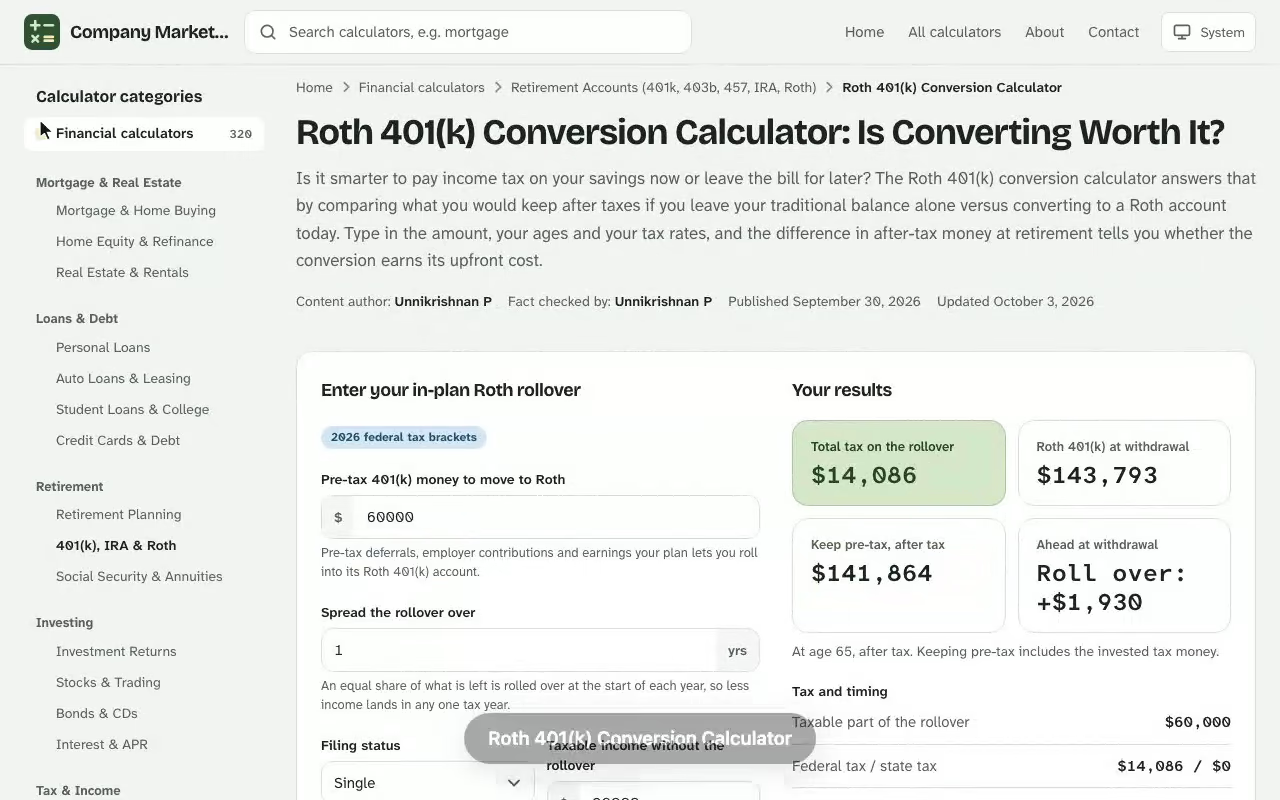
Roth 401(k) Conversion Calculator. Is it smarter to pay income tax on your savings now or leave the bill for later? The Roth 401(k) conversion calculator answers that by comparing what you would keep after taxes if you leave your traditional balance alone versus converting to a Roth account today. Type in the amount, your ages and your tax rates, and the difference in after-tax money at retirement tells you whether the conversion earns its upfront cost. Pair this with the roth ira calculator online for a fuller picture before you make a decision.
Your results
Total tax on the rollover
–
Roth 401(k) at withdrawal
–
Keep pre-tax, after tax
–
Ahead at withdrawal
–
Tax and timing
Taxable part of the rollover–
Federal tax / state tax–
Effective rate on the rollover–
Tax if rolled over all in 2026–
Tax due in 2026–
Break-even retirement tax rate–
Last rollover’s 5-year period ends–
First RMD you would avoid–
An in-plan Roth rollover can’t be undone. Pay the tax through extra paycheck withholding or 2026 estimated payments. Roth 401(k) accounts have had no lifetime required minimum distributions since 2024; pre-tax 401(k) money still does.
Rollover schedule
Tax each year uses the 2026 brackets and your taxable income without the rollover.
Year
Age
Rolled over
Taxable part
Federal tax
State tax
Top federal rate
Roll over or keep pre-tax: year by year
Values at the end of each year. The pre-tax column is shown after the tax you would owe on withdrawal.
Age
Roth 401(k)
Roll over: total after tax
Keep: pre-tax after tax
Keep: tax money invested
Roll over ahead by
Results are estimates for educational purposes and are not financial, tax or legal advice.
How the Roth 401(k) Conversion Calculator Works
A conversion moves pre-tax money into a Roth balance. You owe income tax on the converted amount this year, but the Roth side then grows free of tax and you can withdraw it later without a bill. The calculator models both paths side by side over the years you have left until retirement. On the Roth path you pay the tax bill with personal funds from outside the plan, never from the converted balance, and on the traditional path those same funds stay invested in a taxable investment account. Comparing the two end values is the only fair test, because both paths start with the same total money. The traditional ira vs roth ira calculator uses the same plain-English approach, so you can compare results side by side.
See how the Roth 401(k) Conversion Calculator works: change the inputs and the total tax on the rollover updates instantly. Enter your own numbers in the calculator above.
Each input answers a specific question about your situation, so it helps to know what you are entering before you press the button.
Amount to convert
This is the pre-tax slice you move into the Roth. It can be your whole balance or just part of it. A smaller conversion keeps the added taxable income from pushing you into a higher bracket, which is why many savers convert in slices over several years instead of all at once.
Current age and retirement age
Your current age and your age at retirement set the number of years the converted money compounds. The longer that stretch, the more tax-free growth the Roth side captures, so younger savers usually see the strongest case for converting. The calculator also stops short for savers near their required start date, since it does not model required minimum distributions.
Rate of return
The annual rate of return is a steady assumption, compounded annually, not a forecast. Real investments swing up and down, and anyone investing for decades sees both, so test a cautious rate and an optimistic one before you trust the answer.
Current tax rate
Your current tax rate is the marginal rate that applies to the converted dollars, not your average rate. Because the conversion stacks on top of your other earnings, part of it can land in a higher tax bracket than your paycheck does.
Tax rate at retirement
The tax rate at retirement is the rate you expect to pay on traditional withdrawals later. This is the single most influential guess in the whole model, and the section on break-even rates below shows exactly how much it matters.
Investment tax rate
The investment tax rate is what you expect to pay each year on gains from the money you kept outside the plan. It shrinks the growth of that side account, which is why the Roth path tends to look better the higher this rate is.
Roth In-Plan Conversion Formula
A Roth in-plan conversion keeps the money inside the same employer plan, which is what any Roth in-plan conversion calculator models, and the arithmetic is the same as for any other conversion of a 401(k). With amount converted \(A\), annual return \(r\), years to retirement \(n\), current marginal rate \(t_c\), retirement rate \(t_r\) and investment tax rate \(t_i\), the end values are: Try the roth 401k paycheck calculator online to run your own numbers — everything is calculated in your browser and nothing you enter is stored or sent anywhere.
The second term in the traditional formula is the tax money you did not have to spend, growing in a taxable account at an after-tax rate. The advantage of converting is simply \(V_{\text{Roth}} - V_{\text{Traditional}}\). A positive number means the Roth path leaves you with more spendable money.
Roth Conversion Worked Example: $68,400 at Age 41
Take a saver aged 41 who plans to retire at 65, which is 24 years away. They hold a pre-tax balance and consider a Roth conversion of $68,400. They assume a 6.4% return, a 24% current marginal rate, a 22% rate at retirement and a 15% investment tax rate.
Item
Roth path
Traditional path
Upfront income tax paid (24% of $68,400)
$16,416 from personal funds
$0
401(k) value after 24 years at 6.4%
$303,148
$303,148
Tax owed at withdrawal (22%)
$0
$66,693
Taxable account holding the $16,416 (5.44% after-tax growth)
$0
$58,532
Total after taxes
$303,148
$294,988
The conversion comes out $8,160 ahead. Note how the traditional path loses $66,693 to the future bill but recovers a good share of it through the side account, which is why the gap is modest rather than dramatic.
How the traditional path reaches $294,988, against $303,148 for the Roth path.
When Converting Your 401(k) Pays Off
The answer turns on one comparison: the tax rate you pay now against the tax rate you expect to pay at retirement. For the saver above, the break-even point is where the Roth value equals the traditional value, which happens at
Any retirement rate above 19.3% favors converting, and anything below it favors waiting. The table shows how the result moves when only the retirement rate changes.
Tax rate at retirement
Roth advantage
18%
-$3,966
22%
+$8,160
24%
+$14,223
28%
+$26,349
32%
+$38,475
Savers who expect lower income later, such as a retiree living on modest withdrawals, can find the answer flips. Savers who expect higher rates, or who simply want more certainty about future taxes, tend to gain.
The Roth advantage grows as your retirement tax rate and return rise; at 18% the traditional balance wins.
Taxable Income and Your Marginal Tax Rate
Every converted dollar counts as taxable income for the year, so the size of the conversion decides which marginal tax rate it meets. Converting $68,400 on top of a $90,000 salary may fill one bracket and spill into the next, which means the 24% in the example is a blended estimate. If you want a cleaner result, run the calculator once with the whole amount and once with half, and compare the tax impact of each. Remember that your federal marginal tax rates are only half of the picture, because state or local levies add to the bill in many places.
Testing a $41,300 Roth In-Plan Conversion at Age 52
You are 52, plan to stop work at 67, and your employer's plan has just opened Roth in-plan conversions. Your pre-tax balance is $212,880, and a bonus-free year leaves you well inside the 22% federal bracket. You have $14,000 in a brokerage account earmarked for the tax bill, so you decide to test converting $41,300 rather than the whole balance.
You enter 41,300 as the amount to convert, 52 and 67 for your ages, a 5.8% return, 22% as the current rate, 24% as the rate you expect in retirement (your pension will stack on top of withdrawals), and 15% as the investment tax rate. After you click the button, the result reads:
Upfront tax: $9,086, paid from the brokerage account
Converted balance at 67: $96,213, untouched by tax
Traditional path after tax: $73,122 plus $18,701 in the side account, or $91,823
Roth advantage: $4,390
The break-even retirement rate lands at 19.4%, and your 24% guess sits comfortably above it, so the conversion wins. Before committing, you rerun it with the rate at 24% today instead of 22%, since the extra $41,300 might spill into the next bracket. The advantage drops to $2,690, still positive but thinner. The cap on how much to convert becomes obvious: stop at the top of the 22% bracket, where the gain is largest per dollar.
Your next step is specific. You convert the first $41,300 this year, check the bracket headroom again next January, and leave the $14,000 untouched so you never need to dip into the converted balance. Since you are under 59 1/2, pulling the tax from the plan would have added the 10% penalty, which would have erased the entire $4,390 gain.
Rules to Know Before Converting to a Roth
The math is only useful if the conversion is allowed and handled correctly. Check each of these first:
Tax on the converted amount. You owe income tax on pre-tax contributions and investment gains in the year of the conversion, and the plan reports it as an income tax year event, not as a deduction.
Pay the bill from outside. Using money from the converted balance shrinks the base that grows free of tax, and if you are under 59 1/2 the withdrawn portion can trigger a 10% federal tax penalty.
The five-year clock. To take earnings tax-free, the Roth balance generally must be open for 5 tax years, and the qualifying distributions that follow include those after 59 1/2, for disability, or for a first-time home purchase.
Contributions and deductions. Pre-tax contributions may be tax-deductible when you make them, but a conversion earns no deduction: the calculator treats the converted amount as taxable income, and the Roth balance is funded on an after-tax basis.
Plan eligibility. Not every employer plan allows in-plan conversions, so confirm your eligibility and any minimum amount before you plan around it.
Roth IRA Conversion Calculator vs Converting a 401(k)
A Roth IRA conversion calculator uses almost the same logic, but the account is different. An IRA gives you broader choices of investments and no employer rules, while a conversion of employer money happens inside your retirement plan and follows that plan's limits. The five-year clock, the tax on the converted amount and the need to pay the bill from outside money apply to both. The same inputs work in either calculator; only the rules of the plan or account differ.
What a Conversion Calculator Can and Cannot Tell You
The result is an estimate of future values, not a promise, because the tool applies one steady rate of return every year. Real returns follow the market, and even a broad index such as the S&P 500 has had years of sharp losses, so rerun the inputs with a low and a high return and keep volatility and risk in mind. The model also assumes that you really do have savings in an ordinary savings account or brokerage account to cover the tax, and that your rates stay put for decades.
Calculator disclaimer and assumptions
This tool is for education, not advice. It assumes a constant rate of return, a single flat tax rate for each period, no mandatory payouts before retirement, and that you do not withdraw anything early. Because laws change, talk with a tax advisor about your situation, and bring the results to a financial advisor who can fold the conversion into a broader financial plan.
How to use the result
If the calculator shows a clear gain and you can pay the tax from your own account without strain, a partial conversion each year is a sensible next step. If the answer is close to zero, the decision often comes down to flexibility: Roth money has no forced withdrawals and leaves a cleaner balance for heirs, while traditional money keeps your current taxes low. Either way, rerun the calculator with a different retirement tax rate: if the sign of the advantage flips, your decision hinges on that income guess, and if it holds, you can convert with more confidence about your money later.
Roth 401(k) Conversion Calculator questions
What does a Roth 401(k) conversion calculator do?
It compares two paths for the same pre-tax money: keep it in a traditional balance and pay tax at withdrawal, or convert now, pay the tax today from other funds, and withdraw tax-free later. The difference in after-tax value is the Roth advantage.
Is a Roth in-plan conversion taxable?
Yes. The converted amount counts as taxable income for the year of the conversion, and you owe income tax on pre-tax contributions and earnings. Pay that bill from money outside the account so the full balance keeps growing tax-free.
When does converting to a Roth make sense?
Usually when your tax rate at retirement is expected to be above the break-even rate the calculator shows, when you have many years for tax-free growth, and when you can pay the tax from outside funds.
Why should I pay the conversion tax from outside the plan?
Using plan money shrinks the amount that grows tax-free, and under age 59 1/2 the withdrawn portion can add a 10% federal penalty. The calculator therefore assumes the tax is paid from funds outside the account.
What is the five-year rule for Roth conversions?
To take earnings tax-free, the Roth balance generally must have been open for five tax years, and the withdrawal must be qualified, such as after age 59 1/2, for disability, or for a first-time home purchase. Check your plan's own rules.
Which tax rate should I enter for retirement?
Use your best estimate of the marginal rate on withdrawals, including pensions, Social Security taxation and required distributions. Run the calculator at a low and a high rate to see whether the answer changes sign.
Does this work for a Roth IRA conversion?
The math is almost identical, so the results are a good guide, but IRAs follow different account rules. Confirm eligibility and any plan limits with your provider and a tax advisor.