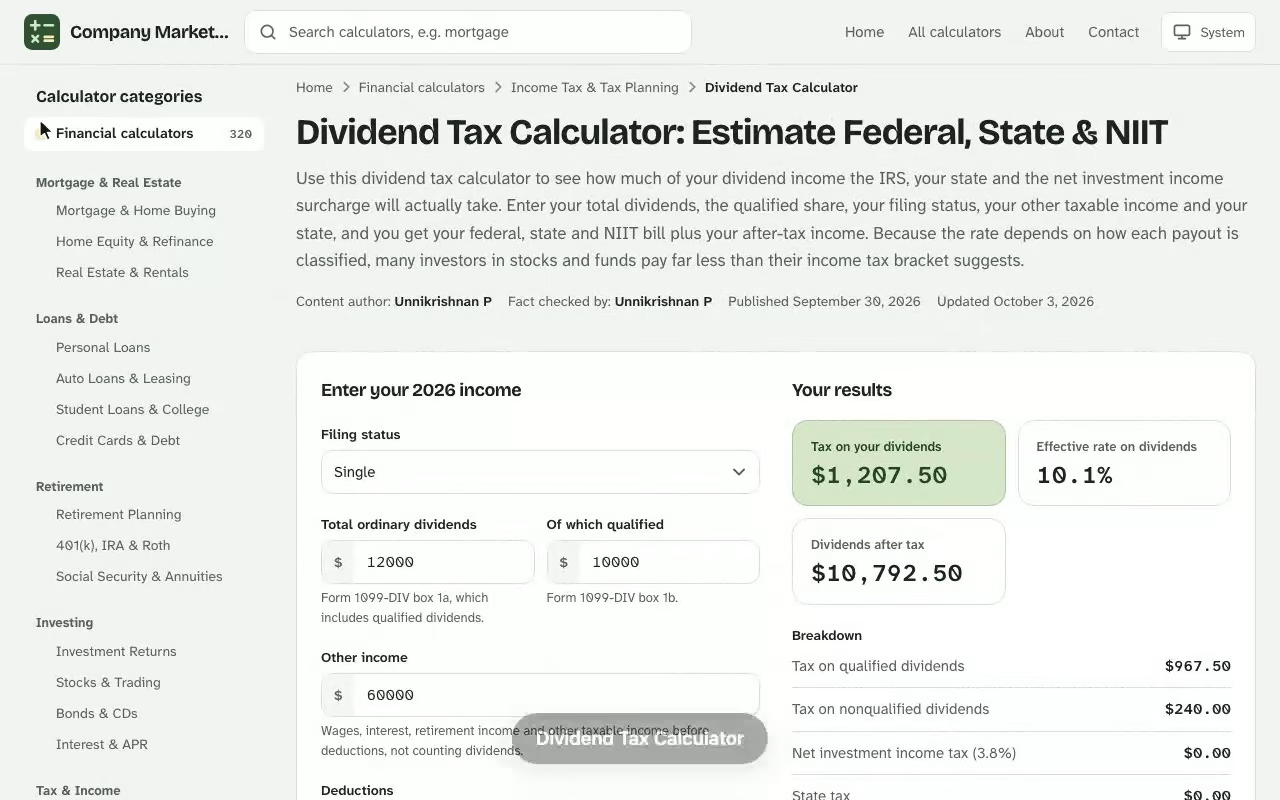
Dividend Tax Calculator. Use this dividend tax calculator to see how much of your dividend income the IRS, your state and the net investment income surcharge will actually take. Enter your total dividends, the qualified share, your filing status, your other taxable income and your state, and you get your federal, state and NIIT bill plus your after-tax income. Because the rate depends on how each payout is classified, many investors in stocks and funds pay far less than their income tax bracket suggests. The income tax calculator online is free to use with no sign-up, and works on desktop and mobile.
Your results
Tax on your dividends
–
Effective rate on dividends
–
Dividends after tax
–
Breakdown
Tax on qualified dividends–
Tax on nonqualified dividends–
Net investment income tax (3.8%)–
State tax–
Taxable income with dividends–
Saved by qualified treatment–
How your dividends are taxed
Dividends sit on top of your other income: nonqualified dividends fill your ordinary brackets first, then qualified dividends use the 2026 capital gains rates.
Portion
Rate
Amount
Tax
2026 qualified dividend rates by taxable income
Filing status
0% up to
15% up to
20% above
3.8% NIIT above (MAGI)
Results are estimates for educational purposes and are not financial, tax or legal advice.
How a Dividend Tax Calculator Works
The tool splits your payouts into two piles, taxes each pile at its own rate, and adds the extras that only apply to some investors. The first pile is qualified dividends, which get preferential rates of 0%, 15% or 20%. The second is ordinary dividends, which are taxed like wages at your regular rate. On top of that, high earners owe a 3.8% surcharge and many residents owe state tax. Pair this with the charitable giving tax savings calculator online for a fuller picture before you make a decision.
A company pays dividends out of its profits, and whether you collect them through a single stock or a mutual fund, the calculator applies the same classification rules to your total. Investing for income does not exempt you either: if you reinvest every payout automatically, the calculator still counts it in the year it is paid, because that is when the IRS does.
The total your tax calculator reports is the sum of four pieces:
Your effective tax rate is then the total divided by your dividends, which shows what each dollar of payout really costs you after every layer is added.
Total annual dividends: the sum of every payment from stocks, ETFs and mutual funds this tax year.
Qualified portion: the share of those payments your broker reports as qualified.
Filing status: single, married filing jointly, married filing separately or head of household.
Other taxable income: wages, interest and gains after deductions, excluding the dividends themselves.
State of residence and any foreign tax withheld.
What you get back
The results show your federal tax on qualified and ordinary dividends, any net investment income tax, your state bill, your tax liability in total and the money left in your pocket. Treat it as an estimate for planning, not a filed return.
Qualified Dividends vs Ordinary Dividends
The single biggest driver of dividend tax is classification. The same $1,000 payment can cost you $0 or $370 in federal tax depending on which pile it lands in, so it pays to know which of your holdings produce which type. The estate tax calculator online uses the same plain-English approach, so you can compare results side by side.
Qualified dividends and the holding period
A payout is qualified when it comes from a US corporation or a qualifying foreign company and you meet the holding period. You must hold the shares for more than 60 days inside the 121-day period that starts 60 days before the ex-dividend date. Most dividends from large US stocks and broad ETFs pass this test. Qualified dividends are taxed at the long-term capital gains rates, which is why people sometimes call them tax-favored income.
See how the Dividend Tax Calculator works: change the inputs and the tax on your dividends updates instantly. Enter your own numbers in the calculator above.
Ordinary dividends and non-qualified dividends
Everything else is an ordinary payout, also called non-qualified dividends. That bucket includes payouts from REITs (real estate investment trusts), money market funds, dividends on stock you held too briefly, and some employee stock options arrangements. These are taxed as ordinary income, so they stack on top of your salary and are charged at your marginal rate, anywhere from 10% to 37%.
Feature
Qualified dividends
Ordinary dividends
Federal rate
0%, 15% or 20%
10% to 37%
Holding requirement
More than 60 days in the 121-day window
None
Typical sources
US stocks, ETFs, many mutual funds
REITs, money market funds, short-held shares
Where it is reported
1099-DIV Box 1b
1099-DIV Box 1a
Dividend Tax Rates and Bands by Filing Status
Your qualified rate depends on where your taxable income lands, measured against thresholds that differ by filing status. These are the 2026 breakpoints for qualified dividends and long-term gains.
Filing status
0% rate up to
15% rate up to
20% rate above
Single
$49,450
$545,500
$545,500
Married filing jointly
$98,900
$613,700
$613,700
Married filing separately
$49,450
$306,850
$306,850
Head of household
$66,200
$579,600
$579,600
Ordinary payouts follow the regular tax brackets. For a single filer in 2026 the federal income tax ladder is 10% up to $12,400, 12% up to $50,400, 22% up to $105,700, 24% up to $201,775, 32% up to $256,225, 35% up to $640,600 and 37% beyond. Dividends sit at the top of your stack, so the bracket your last dollar of other income reaches decides how much of the ordinary pile gets taxed at each step.
Where the example's $80,940 stack sits against the qualified dividend and NIIT lines.
Why your tax bracket is not your dividend rate
Your dividend tax rate is not the same as your bracket, and a common mistake is to apply the top bracket to every payout. Qualified dividends ignore the ladder above and use the separate three-step schedule instead, so someone in the 24% bracket usually pays 15% on qualified dividends. The ordinary tax rates only bite on the non-qualified slice.
NIIT: Net Investment Income Tax on Dividends
The net investment income tax adds 3.8% on top of regular federal tax when your modified adjusted gross income (MAGI) passes a threshold. Dividends count as net investment income, along with interest and capital gains. The surcharge applies to the lesser of your investment income or the amount your MAGI exceeds the line, so it never taxes more than the excess.
These lines are not indexed for inflation, so more households cross them every year. A top-bracket investor can end up at 23.8% on qualified payouts (20% plus 3.8%).
State Tax on Dividend Income
Most states tax dividend income as part of ordinary earnings, while nine states levy no tax on dividends at all: Alaska, Florida, Nevada, South Dakota, Tennessee, Texas, Washington, Wyoming and New Hampshire, which phased its levy out. If you live elsewhere, enter your state's effective rate and the calculator adds it to the federal figure. The calculator multiplies that rate by your total dividends, so 4.5% on $9,640 adds $433.80, while the same payout in Texas adds nothing. This single input can move a retiree's bill by thousands of dollars on a large portfolio.
Worked Example: Dividend Taxes on $9,640 of Payouts
Here is a complete calculation so you can watch your dividends taxed one layer at a time. You are a single filer with $9,640 of dividends this year. Your broker says $7,915 of it, about 82%, is qualified, leaving $1,725 ordinary. Your other taxable income is $71,300 after deductions, your state charges a flat 4.5% and you have no foreign withholding.
Step by step
Ordinary dividends: $71,300 plus $1,725 puts the top of your ordinary stack at $73,025, inside the 22% bracket, so $1,725 × 22% = $379.50.
Qualified dividends: they begin at $73,025, already past the $49,450 line for single filers, so all $7,915 is taxed at 15% = $1,187.25.
NIIT: MAGI is $80,940, far below $200,000, so the surcharge is $0.
State: $9,640 × 4.5% = $433.80.
Piece
Amount taxed
Rate
Tax
Federal on ordinary dividends
$1,725
22%
$379.50
Federal on qualified dividends
$7,915
15%
$1,187.25
Net investment income tax
$0
3.8%
$0.00
State tax
$9,640
4.5%
$433.80
Total
$9,640
20.8% effective
$2,000.55
Your after-tax income from the payouts is $9,640 minus $2,000.55, or $7,639.45. The qualified pile is 82% of the payout yet carries only about 59% of the tax, which shows how much classification matters.
How $9,640 of dividends becomes $7,639.45 after $2,000.55 of tax.
How the answer changes with income and mix
Run the same $9,640 through the calculator with different inputs and the totals separate quickly. With $38,000 of other income and fully qualified payouts, the federal tax is $0 and only the $433.80 state charge remains. With $265,000 of other income and entirely ordinary payouts, the total climbs to $4,174.12. Changing one input at a time shows whether your income level or your mix of holdings drives the bill.
Total tax on the same $9,640 of dividends at different incomes and qualified shares; the outlined cell is the worked example.
Reading Your 1099-DIV and Foreign Tax Credit
Your broker mails a 1099-DIV each January, and its boxes feed the calculator directly. The two that matter most are Box 1a, total ordinary payouts, and Box 1b, the qualified subset. Box 1b is already included in Box 1a, so do not add them together.
Box
What it shows
Tax treatment
1a
Total ordinary dividends
Reported on Schedule B
1b
Qualified dividends
Taxed at 0%, 15% or 20%
2a
Total capital gain distributions
Long-term capital gains rate
3
Nondividend distributions (return of capital)
Reduces your cost basis
7
Foreign tax paid
Credit or deduction
Foreign dividends
If a fund holding foreign dividends withheld tax abroad, Box 7 records it. You can usually claim a foreign tax credit on your tax return, which reduces your US bill dollar for dollar up to a limit. The calculator subtracts the foreign tax withheld you enter from your total.
Checking Dividend Taxes on a Texas Couple's Portfolio
Marguerite and Dale, married and filing jointly in Texas, are deciding whether the real estate fund in their brokerage account belongs there at all. Their 1099-DIV shows $14,285 of dividends: $12,060 in Box 1b (qualified) and $2,225 of ordinary payouts from the fund. Their other taxable income is $118,640 after the standard deduction, and Texas has no state income tax.
They enter $14,285, a qualified portion of 84%, married filing jointly, $118,640 of other income and a 0% state rate, then click Calculate. The ordinary $2,225 stacks on top at $120,865, inside the 22% bracket, so it costs $489.50. The qualified $12,060 starts above the $98,900 joint line for the 0% rate, so it is all taxed at 15%, or $1,809.00. Their MAGI of $132,925 sits far below the $250,000 joint NIIT threshold, so that line reads $0. The dividend tax comes to $2,298.50, an effective rate of 16.1%.
The ordinary slice is 16% of the payout but 21% of the tax, which is what catches Dale's eye. Because REIT payouts are taxed as ordinary income, he reruns the calculator with one change: the fund's $2,225 removed from the taxable account, as if it sat inside his traditional IRA. Qualified dividends of $12,060 still start above $98,900, so the bill falls to $1,809.00, a saving of $489.50 a year.
That number gives them a concrete next step. They keep the index funds in the brokerage account, then place the real estate fund in the IRA at their next rebalance, instead of selling it and realizing a gain.
How to Reduce Tax on Dividends
You cannot change the rules, but you can change where and how you earn the payouts. These tax-efficient moves work for most investors.
Use a retirement account. Inside a Roth IRA payouts grow tax-free; inside a traditional IRA or 401(k) they are tax-deferred. These tax-advantaged accounts shield every payout from annual taxation, and are especially useful for REIT holdings.
Respect the holding period. Selling before 60 days can turn a qualified payout into ordinary income.
Harvest losses.Tax-loss harvesting lets up to $3,000 of net losses offset ordinary income each year.
Consider municipal bonds. Their interest is generally exempt from federal tax, which can beat a taxable payout for high-bracket investors.
Mind your withholding. If dividends are large, adjust your withholding or make an estimated tax payment so you avoid a penalty; the IRS expects estimated taxes quarterly on income without withholding.
A Roth IRA is a tax break paid back to you when retirement arrives, and retirees often benefit most from keeping taxable income low, because qualified payouts stay in the 0% band during retirement and each deduction you claim moves more of them under the line. Enter your lower income into the calculator to test that, and bring the result to a financial advisor if your situation is complicated.
Dividend Tax Rates and Bands in the UK
This calculator covers US federal, state and NIIT tax, so a reader with UK shares needs different rules, which is why the figures below are kept separate. In England the dividend tax rates and bands for 2026/27 are 10.75% in the basic rate band, 35.75% in the higher rate band and 39.35% at the additional rate, after a 2 percentage point tax rise in April 2026. The first £500 is covered by the dividend allowance. A company director's salary & dividend tax calculator also factors in the personal allowance of £12,570, national insurance on pay and the standard tax code, 1257L, to find take home pay.
Band
Dividend income range
2026/27 rate
Basic
£0 to £37,700
10.75%
Higher
£37,701 to £125,140
35.75%
Additional
Above £125,140
39.35%
A tax diagram of these bands looks like a staircase, much as the US schedule does. Because the personal allowance shrinks once earnings pass £100,000, a director's marginal rate can jump well before the top band. Keep the two systems separate: the US figures above do not apply to UK shareholders, and the UK ones do not apply to American filers.
Dividend Tax Calculator questions
How are dividends taxed in the United States?
Dividends are taxed as either qualified or ordinary. Qualified dividends use the lower long-term capital gains rates of 0%, 15% or 20%, while ordinary dividends are taxed at your regular income tax rate, from 10% to 37%. High earners may also owe the 3.8% net investment income tax, and many states add their own tax.
What makes a dividend qualified?
It must come from a US corporation or a qualifying foreign company, and you must hold the shares for more than 60 days during the 121-day period that begins 60 days before the ex-dividend date. Payouts from REITs and money market funds are usually ordinary.
What is the qualified dividend tax rate for 2026?
For a single filer the rate is 0% up to $49,450 of taxable income, 15% up to $545,500 and 20% above that. Married couples filing jointly get 0% up to $98,900 and 15% up to $613,700.
When does the net investment income tax apply to dividends?
The 3.8% NIIT applies when your modified adjusted gross income exceeds $200,000 for single filers and head of household, $250,000 for married filing jointly, or $125,000 for married filing separately. It is charged on the lesser of your net investment income or the amount over the threshold.
Which states do not tax dividend income?
Alaska, Florida, Nevada, South Dakota, Tennessee, Texas, Washington, Wyoming and New Hampshire do not tax dividends. Washington has a separate capital gains tax that may apply in limited cases.
How do I find my dividends on a 1099-DIV?
Box 1a shows total ordinary dividends, which includes the qualified amount shown in Box 1b. Box 7 shows foreign tax paid, which you may be able to claim as a credit.
Do I pay tax on dividends inside a Roth IRA or 401(k)?
Not each year. Dividends in a Roth IRA grow tax-free if you follow the withdrawal rules, and dividends in a traditional IRA or 401(k) are tax-deferred until you withdraw the money.
Is this estimate the same as my tax return?
No. It is a planning estimate based on 2026 federal brackets, your chosen deduction and a flat state rate. Credits, phaseouts and local taxes can change your actual bill, so check your return or ask a tax professional.