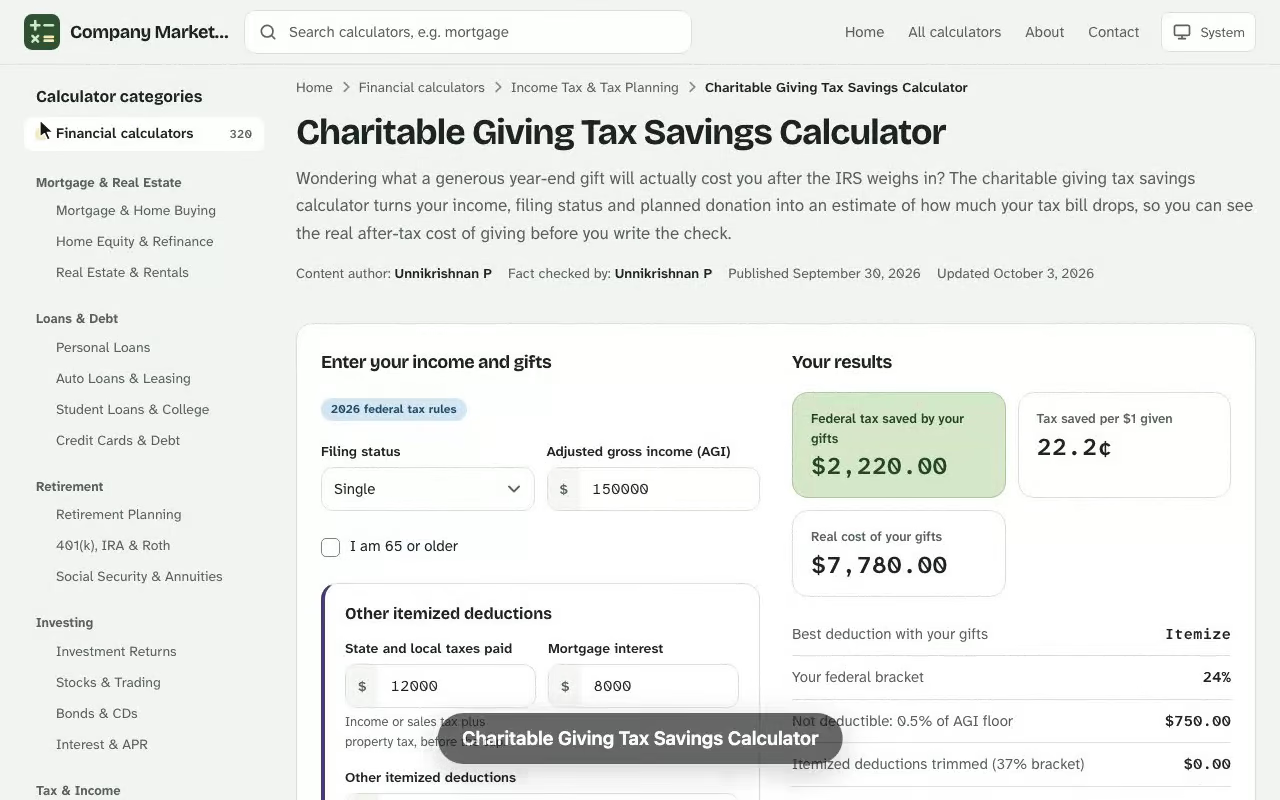
Charitable Giving Tax Savings Calculator. Wondering what a generous year-end gift will actually cost you after the IRS weighs in? The charitable giving tax savings calculator turns your income, filing status and planned donation into an estimate of how much your tax bill drops, so you can see the real after-tax cost of giving before you write the check. If you want to see how the figures change, the income tax calculator online gives you an instant result you can adjust as you go.
Your results
Federal tax saved by your gifts
–
Tax saved per $1 given
–
Real cost of your gifts
–
Best deduction with your gifts–
Your federal bracket–
Not deductible: 0.5% of AGI floor–
Itemized deductions trimmed (37% bracket)–
Carried forward to next year–
Capital gains tax avoided (estimate)–
Federal income tax only, before credits. The real cost is your gifts minus the tax saved and any capital gains tax avoided.
Your tax with and without the gifts
The same 2026 federal return worked out twice. Whichever deduction is larger, standard or itemized, is used in each case.
Without gifts
With gifts
How much of each gift you can deduct if you itemize
Gifts above the AGI limit carry forward for up to five years. The 0.5% floor is taken first from appreciated property, then non-cash items, then cash. Gifts to private non-operating foundations have lower limits and are not covered here.
Gift type
Given
AGI limit
Allowed
0.5% floor
Deductible
Results are estimates for educational purposes and are not financial, tax or legal advice.
How the Charitable Giving Tax Savings Calculator Estimates Your Deduction
A charitable deduction only lowers what you owe if you itemize, so the estimate starts by asking whether your gift pushes your itemized total past the standard deduction. The calculator walks through four checks in order: it caps your gift at the contribution limit, subtracts the new AGI floor, compares the result against the standard deduction, and multiplies the extra deduction by your marginal tax rate. If you want to see how the figures change, the free tax loss harvesting calculator gives you an instant result you can adjust as you go.
The itemized deductions test
Your itemized deductions (mortgage interest, state and local taxes, medical costs above their threshold, and your gift) must beat the standard deduction for the gift to change your return. For 2026 the standard deduction is $16,100 for a single filer and $32,200 for married couples filing jointly. If your other itemized deductions already sit below that line, a gift first fills the gap and only the portion above it creates new savings.
See how the Charitable Giving Tax Savings Calculator works: change the inputs and the federal tax saved by your gifts updates instantly. Enter your own numbers in the calculator above.Itemizing with the gift beats the standard deduction by $12,908 in the worked example.
Why marginal tax rate drives the result
Every extra dollar of deduction removes a dollar of taxable income at the top of your range, so the value of that dollar equals your marginal tax rate. A donor in the 24% bracket keeps 24 cents of every deductible dollar; one in the 12% bracket keeps 12 cents. In the 37% bracket the benefit is now capped at 35 cents per dollar.
Charitable Tax Savings Calculator Inputs You Need
A good charitable tax savings calculator needs only a handful of figures, and most are on last year's return. Gather these before you start: If you want to see how the figures change, the dividend tax calculator online gives you an instant result you can adjust as you go.
Adjusted gross income (AGI): your total income minus above-the-line adjustments, found on the first page of your return.
Filing status: single, married filing jointly or head of household, which sets the standard deduction you are competing against.
Other itemized deductions: everything you would itemize apart from this donation.
Cash contribution: money given to a qualified charity this year.
Appreciated securities: the fair market value and cost basis of any shares you plan to give instead of cash.
Tax rates: your federal marginal rate, your state rate and your long-term capital gain rate.
Click the calculate button and the tool returns your deduction after the floor, your federal and state income tax savings, and the capital gains tax you avoid.
Charitable Contribution Tax Deduction Rules for 2026
Every taxpayer who itemizes faces the same arithmetic: a gift reduces taxable income, and lower taxable income means less income tax owed. The calculator applies each rule below, in order, to the gift you enter.
The 2026 tax law changed three things that matter to every charitable deduction estimate. Knowing them explains why a result may look smaller than it did a few years ago.
The 0.5% AGI floor
If you itemize, only the part of your giving above the 0.5% AGI floor is deductible. With an AGI of $138,400 the floor is $692, so the first $692 you give each year earns no deduction at all.
Contribution limit: 60% of AGI and 30% of AGI
Cash gifts to a public charity are deductible up to 60% of AGI. Gifts of appreciated assets are limited to 30% of AGI. Anything above those ceilings is carried forward and can be deducted over the following five years.
The non-itemizer deduction
A non-itemizer who takes the standard deduction can now deduct up to $1,000 as a single filer or $2,000 as a joint filer, but only for cash given directly to a public charity. Gifts to a private foundation or a donor-advised fund do not qualify. The organization should be tax-exempt under 501(c)(3) of the tax code.
Tax Benefit of Donating Appreciated Securities
Giving stock you have held for more than a year is often the most efficient charitable donation. You deduct the full fair market value, and neither you nor the charity pays tax on the growth.
Capital gains tax you avoid
If you sold the shares and donated the cash, you would owe capital gains tax on the unrealized gain first. The gain percentage is the gain divided by the fair market value, and the capital gain you sidestep equals the gain multiplied by your long-term capital gain rate. Donating the shares directly means the after-tax proceeds of a sale never have to fund the gift, so more of your money reaches the cause.
Cost basis and fair market value
Fair market value is what the shares would sell for today. Your cost basis is what you originally paid, adjusted for splits. The gap between them is the gain; the larger the gap, the more attractive a gift of stock becomes compared with cash. If you would never have sold the position, giving it creates no extra saving beyond a cash gift of the same size.
Worked Example: Charitable Tax Benefit Calculator Results
Consider a single filer with an AGI of $138,400, other itemized deductions of $14,200, a 24% federal rate, a 4.5% state rate and a 15% long-term capital gain rate. This donor plans to give $6,500 in cash plus stock worth $9,000 that was bought for $3,600, for a total gift of $15,500.
The deduction after the floor and the savings follow from these formulas:
The gift costs $15,500 in value but trims the tax bill by about $4,574, so the effective cost of giving is roughly $10,926. Without the gift this donor would have taken the standard deduction, which is why the baseline in the extra-deduction step is $16,100 and not the $14,200 of other itemized deductions.
Tax savings of $4,574 cut the effective cost of the $15,500 gift to $10,926.
A Joint Return Run Through the Charitable Tax Savings Calculator
Dana and Marcus Whitfield file jointly and want to move $12,400 of fund shares, bought years ago for $4,150, to their local food bank before December 31. Their AGI is $164,820 and their other itemized deductions, mostly mortgage interest and property tax, total $21,340. They also plan a $2,200 cash gift. They suspect the gift will not change their return, because $21,340 sits well under the $32,200 joint standard deduction.
They enter the AGI, joint filing status, $21,340 of other deductions, $2,200 in cash, the $12,400 market value and $4,150 basis, a 22% federal rate, a 5.0% state rate and a 15% long-term rate. The calculator subtracts the $824.10 AGI floor from the $14,600 gift, leaving a $13,775.90 deduction and an itemized total of $35,115.90.
Extra deduction over the standard line: $2,915.90, worth $641.50 in federal tax at 22%.
State savings: $13,775.90 × 5.0% = $688.80.
Capital gain avoided: ($12,400 − $4,150) × 15% = $1,237.50.
The estimated tax savings come to $2,567.79. Most of it comes from the shares, not the deduction, and the 30% of AGI ceiling of $49,446 is nowhere near binding. The federal piece looks thin because the couple clears the standard deduction by only $2,915.90. So they rerun the numbers with next year's planned $2,200 cash gift added now: the extra deduction rises to $5,115.90 and the federal saving to $1,125.50. They decide to make both gifts in the same December and take the standard deduction next year, a simple case of bunching.
Testing Bunching and Donor-Advised Funds with the Charitable Tax Savings Calculator
If your itemized total hovers near the standard deduction, bunching can turn a wasted gift into a deductible one. Instead of giving $5,000 each year, you give $10,000 every other year and itemize in the big year, then take the standard deduction in the off year. To test it, enter the bunched amount in the cash contribution field, note the estimated tax savings, then rerun with a single year's gift and compare the two results.
Using a donor-advised fund
A donor-advised fund lets you take the deduction now and recommend grants to charities later. The donor gets the full deduction in the year of the contribution, which makes the fund a natural partner for bunching and for gifts of stock. Enter a donor-advised fund contribution as the gift amount, and the calculator will show the deduction taken in the contribution year.
Estate and tax planning
Larger gifts or bequests can also reduce estate tax, but the calculator covers only income and capital gains tax. Review your tax planning with a tax advisor before moving big positions, and keep the IRS receipt for every gift above $250.
Reading Your Tax Savings Result
Treat the output as an estimate of tax savings, not a guarantee. The estimated tax savings assume you itemize, that your rate stays constant across the extra deduction, and that the charity is a qualified public one. A large gift can push part of your income into a lower tax bracket, in which case the true saving falls slightly below the figure shown.
Your income tax situation can also shift between the time you run the estimate and the time you file, so rerun it after a raise, a bonus or a change in filing status. Small changes to AGI move the floor, the contribution limits and the bracket all at once.
Check three things when you review the number. First, did the gift clear the standard deduction? Second, did either contribution limit cut the gift short and create a carryforward? Third, is the state saving realistic for the place where you file? Because the tax bill depends on your whole return, a quick check with a tax advisor is worth it for gifts above a few thousand dollars.
Does a charitable donation lower my taxes if I take the standard deduction?
Usually not. A gift reduces your taxable income only when your itemized deductions, including the gift, exceed the standard deduction. Starting in 2026 a separate deduction of up to $1,000 for single filers and $2,000 for joint filers covers cash gifts made directly to public charities if you do not itemize.
What is the 0.5% AGI floor?
If you itemize, only the part of your charitable giving above 0.5% of your adjusted gross income is deductible. With an AGI of $100,000, the first $500 you give in a year earns no deduction.
How much of my income can I deduct for charity?
Cash gifts to public charities are deductible up to 60% of AGI, and gifts of appreciated assets up to 30% of AGI. Anything above those limits can be carried forward and deducted over the next five years.
Why donate appreciated stock instead of cash?
If you have held shares for more than a year, you can deduct their full fair market value and avoid the capital gains tax you would owe by selling them first. The charity, being tax-exempt, also pays nothing on the growth.
Which marginal tax rate should I enter?
Enter the bracket that applies to the top slice of your taxable income, not your average rate. In the 37% bracket the calculator values each deducted dollar at 35 cents, matching the 2026 cap.
Does a donor-advised fund contribution count?
Yes, if you itemize. A gift to a donor-advised fund is deductible in the year you make it, even though grants to charities may come later. It does not qualify for the non-itemizer deduction.
What is bunching and how can I test it?
Bunching combines two or more years of planned giving into one year so your itemized deductions clear the standard deduction, then you take the standard deduction in the off year. Enter the combined amount as your contribution and compare the savings with a single year's gift.
How accurate is this tax savings estimate?
It is a planning estimate based on the rates and limits you enter and simplified 2026 rules. State rules, phase-outs and other items on your return can change the result, so confirm the figure with a tax advisor before you give.