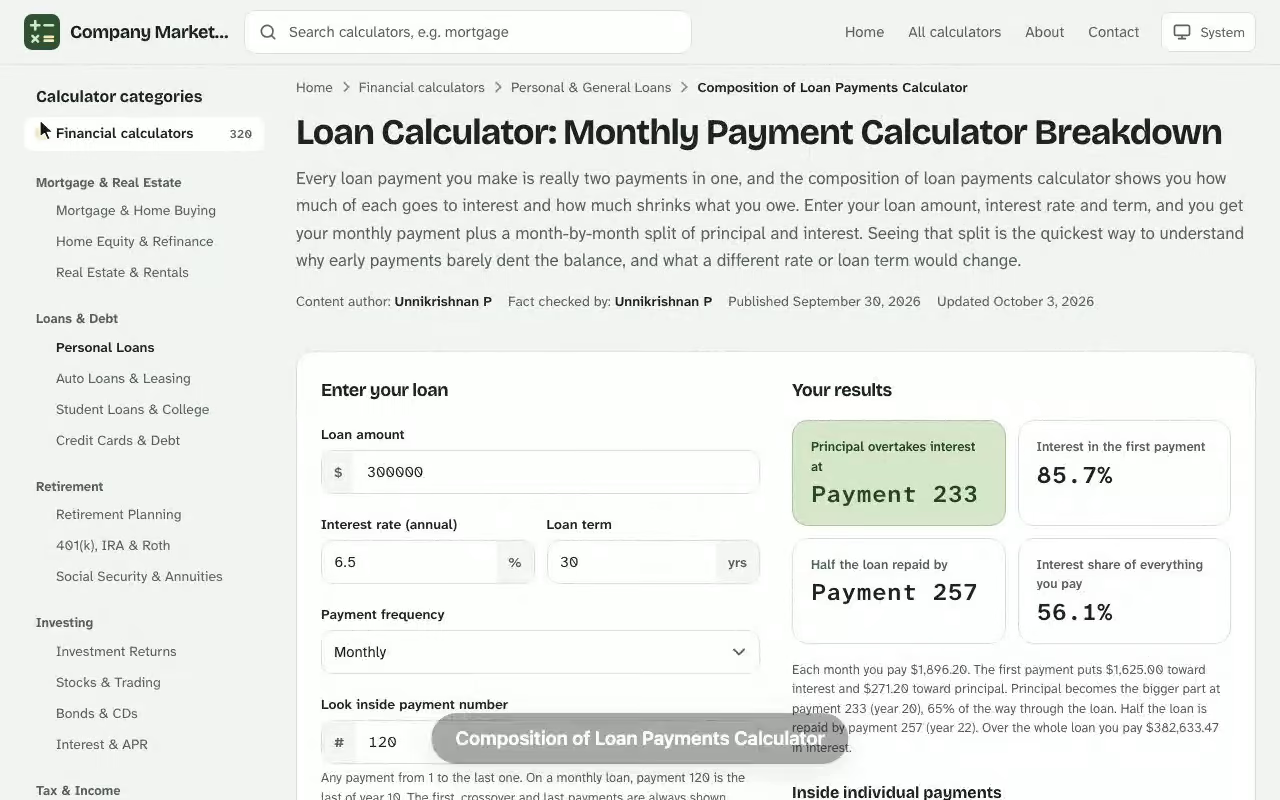
Composition of Loan Payments Calculator. Every loan payment you make is really two payments in one, and the composition of loan payments calculator shows you how much of each goes to interest and how much shrinks what you owe. Enter your loan amount, interest rate and term, and you get your monthly payment plus a month-by-month split of principal and interest. Seeing that split is the quickest way to understand why early payments barely dent the balance, and what a different rate or loan term would change. Try the payment calculator online to run your own numbers — everything is calculated in your browser and nothing you enter is stored or sent anywhere.
Your results
Principal overtakes interest at
–
Interest in the first payment
–
Half the loan repaid by
–
Interest share of everything you pay
–
–
Inside individual payments
Payment
Interest
Principal
Interest share
Balance after
How the mix changes year by year
Each year's payments split into interest and principal. The bar shows the share that went to interest.
Year
Paid
Interest
Principal
Interest share
Balance
Results are estimates for educational purposes and are not financial, tax or legal advice.
What the Composition of Loan Payments Calculator Shows
A loan payment is a fixed amount, but what it is made of changes every month. Each payment first covers the interest that built up on your outstanding balance since the last payment, and whatever is left over repays principal. The composition of loan payments calculator separates those two pieces for every payment on an amortized loan, so you see the principal and interest breakdown instead of one lump total. The 365 360 loan calculator online uses the same plain-English approach, so you can compare results side by side.
Most lenders quote only the payment amount, which hides the split. A good loan calculator assumes equal monthly installments at a fixed interest rate, then walks through the loan payment by payment until the balance reaches zero. The result is a clear picture of what you pay the lender for the privilege of borrowing and how quickly you build ownership of whatever the loan paid for.
How to Use This Loan Calculator for a Payment Breakdown
You only need three facts from your loan offer. Work through them in order: The 365 365 loan calculator online uses the same plain-English approach, so you can compare results side by side.
Enter the loan amount you plan to borrow, before any down payment is subtracted if you are financing only part of a purchase.
Type the annual interest rate from your lender's quote.
Choose the loan term in years or months, or type the number of payments directly.
Pick how often you will pay, then click the Calculate button.
The calculator returns four things you can act on:
Your payment amount for each period.
The total interest you will pay over the life of the loan.
The total payments, meaning principal plus interest.
A stacked column view of principal against interest, so the monthly payments are visible as slices rather than a single number.
Change any input and the breakdown updates, which makes it easy to compare two offers side by side before you sign. Treat it as a monthly payment calculator first and a cost explorer second: the payment tells you whether the loan fits, and the breakdown tells you what it really costs.
Loan Payment Calculator Inputs Explained
Each field in a loan payment calculator controls one part of the breakdown. Knowing what each one does helps you spot a number that does not match your paperwork.
Loan amount
The loan amount is the principal you borrow at the start. Fees such as an origination fee are sometimes added to it, so the figure that accrues interest can be larger than the cash you receive. Enter the amount on your loan estimate rather than the sticker price of the purchase.
Interest rate
The interest rate is the yearly cost of borrowing, expressed as a percentage of the outstanding balance. Many borrowers confuse it with the annual percentage rate (APR), which folds certain loan fees into one yearly figure. If you want the payment your lender will actually bill, use the rate on the note; if you want to compare offers, use the APR.
Periodic rate
Interest accrues each period, so the calculator divides the annual rate by the number of payments per year. A 5.85% rate paid monthly becomes a periodic rate of 0.4875% per month.
Most consumer loans compound monthly, which means each month's interest is calculated on the balance left after the previous payment. Because you pay down principal as you go, this compounding works in your favor on an amortized loan: the compound interest charged keeps shrinking instead of piling on top of itself.
Loan term
The loan term, also called the repayment period, is how long you have to pay the balance down to zero. A longer term lowers each payment but gives interest more time to accumulate, which is why the term has an outsized effect on your total cost.
Payment frequency
Payment frequency sets how many payments you make each year. Common choices are weekly, biweekly, monthly, quarterly, semiannually and annually. Paying more often than monthly can trim interest slightly because the balance drops sooner.
Number of payments
The number of payments is simply the loan term multiplied by the payment frequency. A five-year loan paid monthly has 60 payments; the same loan paid biweekly has 130.
The Monthly Payment Formula Behind Your Loan Repayment
The standard monthly payment on a fixed-rate amortized loan comes from one formula, where P is the loan amount, r is the periodic rate and n is the number of payments:
$$M = P \times \frac{r\,(1+r)^{n}}{(1+r)^{n} - 1}$$
Splitting each payment into interest and principal
Once you know M, every payment divides in two. The interest portion is the previous balance times the periodic rate, and the principal portion is whatever remains of the payment:
$$\text{Interest}_k = B_{k-1} \times r \qquad \text{Principal}_k = M - \text{Interest}_k$$
The new balance is the old balance minus that principal portion. Because the balance falls a little every month, the interest portion falls with it, and the principal portion grows by the same amount.
Principal and Interest in a Worked Example
Suppose you borrow $38,650 at a fixed 5.85% for 60 months. The periodic rate is 0.4875%, and the formula gives a payment of $744.52. In month one, interest is $38,650 × 0.004875 = $188.42, so $556.10 goes to principal and the balance drops to $38,093.90. The table below shows how that split moves as the loan ages.
Month
Payment
Interest
Principal
Remaining balance
1
$744.52
$188.42
$556.10
$38,093.90
12
$744.52
$157.86
$586.66
$31,794.93
24
$744.52
$122.61
$621.91
$24,527.92
36
$744.52
$85.23
$659.29
$16,824.18
48
$744.52
$45.61
$698.91
$8,657.49
60
$744.55
$3.61
$740.94
$0.00
The final payment is three cents higher because each month's interest is rounded to the cent, and the last payment absorbs the leftover pennies.
How Amortization Changes Your Payment Breakdown
Amortization is the process of paying a balance down through scheduled payments, and it is front-loaded with interest. In the example, interest takes 25.3% of the first payment but only 0.5% of the last. Your payment never changes, yet the share that reduces the balance climbs from 74.7% to 99.5%.
This is why an amortization table matters when you are deciding whether to prepay. An extra payment in the first year removes principal that would have generated interest for four more years, while the same extra payment in year five saves almost nothing.
Total interest
Total interest is the sum of the interest portion from every payment. For this loan it comes to $6,021.23, the real price of borrowing the money over five years.
Total payments
Total payments are the monthly payments added up, which is the monthly payment multiplied by the number of payments and equals the loan amount plus total interest paid. Here that is $44,671.23, so the total cost of the loan is about 15.6% more than the $38,650 you received.
Total interest sits on top of the amount borrowed to give the total cost of the loan.
Reading the Yearly Loan Payment Breakdown
Looking at a whole year at a time smooths out the month-to-month noise. Each year you pay $8,934.24 in total, and the loan payment breakdown below shows how the mix shifts.
Year
Interest paid
Principal repaid
Balance at year end
1
$2,079.17
$6,855.07
$31,794.93
2
$1,667.23
$7,267.01
$24,527.92
3
$1,230.50
$7,703.74
$16,824.18
4
$767.55
$8,166.69
$8,657.49
5
$276.78
$8,657.49
$0.00
Each year's payments total $8,934, but the interest slice shrinks while the principal slice grows.
Read the chart from left to right: the column height never changes, but the green principal share swallows the purple interest share. By year five, interest is only $276.78 of the $8,934 you pay, compared with $2,079.17 in year one.
How Loan Term and Rate Change Monthly Loan Payments
Term and rate are the two levers a borrower can compare before signing. The table holds the $38,650 amount and the 5.85% rate fixed and changes only the repayment period.
Loan term
Monthly payment
Total interest
36 months
$1,173.18
$3,585
48 months
$905.04
$4,792
60 months
$744.52
$6,021
72 months
$637.81
$7,272
84 months
$561.85
$8,545
Total interest climbs with both the rate and the term; the outlined cell is the worked example.
Shorter versus longer repayment period
Stretching from 36 to 84 months cuts your payment by $611.33 a month, but it adds $4,960 in interest. If your budget can handle the higher payment, the shorter term is almost always cheaper.
Rate sensitivity
A one-point change in rate matters less than a two-year change in term at this size, but it still adds up: at 6.85% over 60 months the same loan costs $7,105 in interest, which is $1,084 more than at 5.85%.
Pricing a Used Truck Loan with the Monthly Payment Calculator
An electrician earning $5,480 a month before tax is financing a used work truck and dealer financing has come back at 7.35% over 48 months. The amount to finance, after the down payment, is $21,875. Before agreeing, the electrician opens the calculator and types in those three values.
The calculator returns a payment of $527.38 and total interest of $3,439.41. The breakdown for payment one is the more revealing part: $133.98 of it is interest and $393.40 is principal, so 25.4% of the first payment goes to the lender. Across the first 12 payments, $1,445.47 goes to interest and the balance is still $16,991.91.
Two comparisons follow. The first is against a common guideline that a vehicle payment should stay under about 10% of gross monthly income, which here is $548. At $527.38 the payment is 9.6% of income, so the loan fits. Switching the term to 36 months raises the payment to $678.94, or 12.4% of income, which breaks the guideline even though it saves $872.48 in interest.
The second comparison is the rate. A local credit union has prequalified the electrician at 6.49%, so the electrician reruns the 48-month loan with only the rate changed. The payment drops to $518.66 and total interest to $3,020.86, a saving of $418.55. That figure is what decides the next step: the electrician declines the dealer financing and takes the credit union offer to the dealership.
Loan Repayment on an Amortized Loan: How Secured and Unsecured Loans Change the Split
An amortized loan is any loan repaid in regular installments that cover both principal and interest until the balance is gone. Whether it is secured or unsecured changes the risk to the lender, and therefore the rate you are offered, but not the payment math.
Secured loans
Secured loans are backed by collateral, such as the car or house you are buying. The lender holds a lien on that asset until the debt is paid, and if you default, the lender can repossess it. That safety usually earns a lower rate, and a lower rate means a smaller interest share in every payment, so more of each payment goes to principal.
Unsecured loans
Unsecured loans have no collateral, so the lender relies on your credit and income. Rates run higher, which raises the interest slice in each payment and slows how fast the balance falls, but nothing you own is pledged.
Student loans, auto loans and personal loans
All three follow the same amortization pattern, and the same calculator works for each. Common variations include:
Student loans, which may carry an origination fee that raises the balance on day one.
Auto loans, usually secured by the vehicle and often shorter than other loan types.
Personal loans, typically unsecured and repaid over a few years.
Mortgages, the longest of the group, covered in the next section.
Whether you are repaying a student loan, an auto loan or a personal loan, the schedule is built the same way, so one calculator covers all of them. A bond or a deferred loan works differently: it repays one lump sum at loan maturity, so there is no periodic principal and interest split to analyze. A zero-coupon bond is one example.
Mortgage Calculator vs Loan Payment Calculator
A mortgage calculator wraps the same amortization math in extra housing costs, so it answers a slightly different question. A basic loan payment calculator isolates principal and interest, which is exactly what you want when studying the composition of a payment. A mortgage calculator typically adds:
A down payment, which reduces the amount you finance.
Property taxes, collected monthly alongside your mortgage payment.
Homeowners insurance, required by nearly every lender.
Private mortgage insurance, often charged when your down payment is under 20%.
Closing costs, which sit outside the monthly figure but affect how much cash you need.
Taxes, insurance and fees sit on top of the principal and interest portion, which is the only part a composition view splits. Use a mortgage calculator for the full housing bill and a loan payment calculator when you want to see only how principal and interest evolve. As the principal portion accumulates, so does your equity, and that equity is what you tap if you later choose to refinance.
Ways to Lower Your Payment Amount and Pay Off Early
Once you see how much of an early payment goes to interest, a few moves become more attractive:
Make extra payments toward principal, ideally early in the loan, and confirm that your lender applies them to principal rather than to the next scheduled installment.
Prepay a lump of savings when you receive a bonus, since every dollar that reduces the balance also reduces future interest.
Switch to biweekly payments if your lender allows it, which creates one extra monthly payment each year.
Refinance if your credit score has improved and lower rates are on offer.
Round your payment up to a figure well above the minimum payment.
See how the Composition of Loan Payments Calculator works: change the inputs and the principal overtakes interest at updates instantly. Enter your own numbers in the calculator above.
Credit score and fees
Your credit score shapes the rate you are offered, and a lower rate cuts the interest portion of every payment in the breakdown. Loan fees work the other way, adding to the balance that interest is charged on.
Using a Payment Calculator Before You Borrow
A payment calculator is a planning tool, not a commitment. Before you accept an offer, run the numbers for the amount, rate and term you were quoted, then check the principal and interest split and the total interest. Run them again with a shorter term and a slightly lower rate to see what negotiating could be worth. Your bank, a credit union and an online lender will each give you slightly different terms, and the borrower who compares offers tends to pay less.
The breakdown also tells you how the loan behaves once you own it. A payment that is mostly interest in year one means early extra payments pay off most, and a total interest figure that looks high is a cue to shorten the term. Check that the payment fits your monthly income and budget, because borrowing is debt that must be repaid on schedule, and a lower payment from a longer term only moves cost into interest. Student borrowers can weigh the payment against the annual salary they expect, and financial aid or savings that reduce the amount borrowed shrink every line of the breakdown. A few minutes in a calculator before signing is a cheap piece of finance homework, and it keeps the financial decision in your hands rather than the lender's.
Composition of Loan Payments Calculator questions
What does the composition of loan payments mean?
It is the split of each payment between interest, which pays the lender for the money you borrowed, and principal, which reduces the balance you owe. On a fixed-rate amortized loan the payment stays the same while the split shifts toward principal every period.
Why is so much of my early payment interest?
Interest is charged on the outstanding balance, which is largest at the start. Early payments therefore carry the most interest, and as the balance falls the interest portion shrinks and the principal portion grows.
How is the monthly loan payment calculated?
The calculator converts your annual rate to a rate per payment period, then applies the standard amortization formula to the loan amount and the number of payments so that the balance reaches zero at the last payment.
How does a longer loan term change total interest?
A longer term lowers each payment but gives interest more time to accumulate, so total interest rises. Compare two terms by changing only the loan term and reading the total interest result.
What is the difference between the interest rate and the APR?
The interest rate is the yearly cost of the balance alone. The APR also folds in certain lender fees, so it is better for comparing offers, while the rate on your loan note is what sets the payment.
Does paying more often than monthly save interest?
Slightly. Paying weekly or every two weeks reduces the balance sooner, so less interest accrues between payments. Change the Pay back option to compare the results.
Can I use this calculator for auto, student and personal loans?
Yes, as long as the loan is repaid in equal installments at a fixed rate. Lump-sum loans and bonds, which pay everything at maturity, do not have a periodic principal and interest split.
What does the compound setting do?
It sets how often interest is added to the balance. Most consumer loans compound monthly, which is the default here. More frequent compounding raises the effective cost slightly.