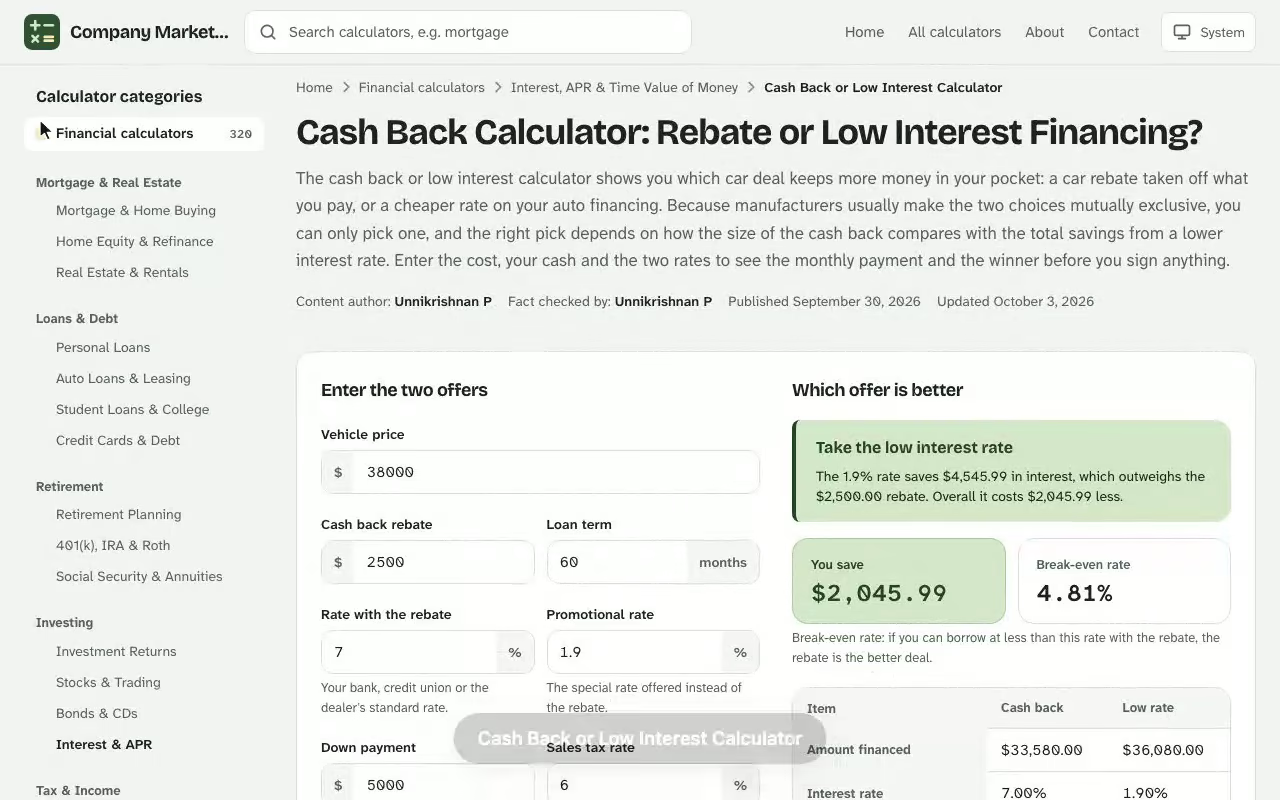
Cash Back or Low Interest Calculator. The cash back or low interest calculator shows you which car deal keeps more money in your pocket: a car rebate taken off what you pay, or a cheaper rate on your auto financing. Because manufacturers usually make the two choices mutually exclusive, you can only pick one, and the right pick depends on how the size of the cash back compares with the total savings from a lower interest rate. Enter the cost, your cash and the two rates to see the monthly payment and the winner before you sign anything. The free interest calculator uses the same plain-English approach, so you can compare results side by side.
Which offer is better
–
You save
–
Break-even rate
–
Break-even rate: if you can borrow at less than this rate with the rebate, the rebate is the better deal.
Item
Cash back
Low rate
Results are estimates for educational purposes and are not financial, tax or legal advice.
How the Cash Back or Low Interest Calculator Compares Both Offers
Every purchase runs through the same engine twice. In the first run, the manufacturer's cash back rebate comes off the amount you borrow, but you pay the standard market rate. In the second run, nothing comes off what you borrow, yet the promotional APR replaces the market rate. The calculator then lines up the monthly installment, total interest and total cost for each version, so the cheaper path is visible at a glance. The compound savings calculator is free to use with no sign-up, and works on desktop and mobile.
Down Payment, Trade-In and Term Inputs
A good cash back calculator asks for the same handful of facts every time. Start with the sales price of the vehicle, then add the sales tax rate and any title and registration fees. Next come your cash down payment, your car's trade in value and the balance still owed on it, then the loan term in months. Last, type the cash back amount, the promotional APR you were quoted and the market rate you would otherwise receive from a bank. Leave out anything that does not apply to your purchase, such as an old car you plan to swap, and the result stays accurate.
Input
Example value
Vehicle cost
$36,450.00
Tax at 7%
$2,551.50
Cash put in at signing
$3,800.00
Cash back amount
$2,750.00
Standard market rate
7.4%
Promotional rate
2.9%
Term
60 months
Worked Example: Low APR vs. Cash Back Calculator Results
Take a $36,450 crossover with a 7% tax bill and $3,800 of your own cash. The showroom offers either $2,750 cash back or a 2.9% rate in place of the usual 7.4%, and you plan to borrow for 60 months. Both paths start from the same $35,201.50 (the sticker plus tax, minus your cash); only the cash back path subtracts the $2,750 from it. Each path then uses the standard amortization formula: The apr calculator uses the same plain-English approach, so you can compare results side by side.
$$M = P \times \frac{r}{1-(1+r)^{-n}}$$
Here \(M\) is what you pay each month, \(P\) is the amount borrowed, \(r\) is the monthly rate (the annual rate divided by 12) and \(n\) is the number of months. Total interest is then \(M \times n - P\).
Measure
Cash back path
Promo rate path
Amount borrowed
$32,451.50
$35,201.50
Rate
7.4%
2.9%
Installment per month
$648.72
$630.96
Interest paid
$6,471.73
$2,656.21
Sum of 60 installments
$38,923.23
$37,857.71
Total cost with your cash
$42,723.23
$41,657.71
The promotional rate wins by $1,065.52. It trims interest by $3,815.52, which is well above the $2,750 you would receive under the cash back offer. Notice the trap in the monthly figures alone: the cash back path asks for a larger check every month in exchange for a smaller balance, so the cheaper path here is also the one with a lower installment, and it is the offer that saves you more money over the full term.
Break-Even Interest Rate
Hold everything else fixed and slide the promotional rate upward. The two deals tie at roughly 4.03%. Any quote below that figure favors the low interest rate offer; any quote above it favors taking the cash. Knowing the tipping point lets you judge a dealer's quote quickly, even before you open the calculator again.
The low rate beats the cash back until the quoted rate climbs past about 4.03%.
Treat the low rate vs. cash back decision as a two-step test. First compare the quote with the break-even interest rate: if the figure you were given is well under it, a low rate is almost always the better car deal, whatever the sticker looks like. Second, check the term. A rate that wins at 60 months can lose at 36, so rerun the calculator with the term you would truly choose for the car rather than the longest one the finance office will write.
When a Cash Rebate Beats Low-Interest Financing on a New Car
A fixed cash back amount does not grow, while interest keeps accumulating, so the cash rebate tends to win on short terms and on small amounts borrowed. A longer loan term gives the cheaper rate more months to save you money. The table reuses the example above and changes only the term.
Term
Interest, cash back path
Interest, promo rate path
Better choice
36 months
$3,834.83
$1,595.96
Cash back, by $511.12
48 months
$5,138.65
$2,123.62
Promo rate, by $265.03
60 months
$6,471.73
$2,656.21
Promo rate, by $1,065.52
72 months
$7,833.94
$3,193.71
Promo rate, by $1,890.23
84 months
$9,225.10
$3,736.13
Promo rate, by $2,738.97
Why Longer Terms Favor the Promotional Rate
At 36 months, the interest difference between the two paths is only $2,238.88, so the $2,750 cash back wins. By 84 months the difference reaches $5,488.97, and the cash back no longer comes close. Every extra year multiplies the gap created by a few percentage points of rate. Be careful with the long end, though: stretching to 84 months with little cash down invites an upside-down loan, where the car is depreciating faster than the loan balance shrinks, and a deal that looked cheaper on paper can leave you owing more than the car is worth.
Interest saved by the 2.9% rate grows with every extra year, passing the $2,750 cash back after 36 months.
As a rule of thumb for this example, a 3.5% promotional rate still wins by $500.63, while a 5.0% quote hands the win back to the cash, which then comes out $934.51 ahead. Use that spread to see how forgiving each choice is when a quote shifts at the last minute: a car buyer who sees the rate rise by a single percentage point at signing should rerun the numbers before agreeing.
Checking a 1.9% Low APR Quote Against $1,500 Cash Back on a New Hatchback
Marguerite has a new hatchback on the lot at $27,890 and a credit union pre-approval at 6.9% for 48 months. The showroom has put two choices on the table: $1,500 cash back, or 1.9% financing for buyers in its top credit tier. She cannot take both, so she opens the calculator to see whether the cash back or the cheaper rate saves her more, and enters what she knows: the $27,890 sticker, a 6.5% tax rate (which adds $1,812.85), $2,400 of her own cash, the $1,500 reduction, 1.9% as the promotional rate and her 6.9% pre-approval as the market rate.
The results come back side by side. The cash back path borrows $25,802.85 and costs $616.68 a month, with $3,798.03 of interest. The 1.9% path borrows $27,302.85 and costs $591.15 a month, with only $1,072.25 of interest. That interest gap is $2,725.78, and after subtracting the $1,500 she would not receive, the cheaper rate comes out $1,225.78 ahead over 48 months. The break-even sits near 4.02%, far above the 1.9% she was quoted, so the cash back is not close.
Before she commits, she changes one input: the term, from 48 to 36 months. The answer flips. At 36 months the cash back wins by $970.61, because three years leaves the low rate too little time to outrun a fixed reduction. She checks what a 36-month schedule would do to her monthly budget, decides the 48-month term is the one she actually wants, and signs for the 1.9% financing, keeping the printed results to confirm the figures match the contract before she hands over her deposit.
How Credit, Trade-In Value and Taxes Change the Better Deal
The best advertised rate is reserved for well-qualified buyers, which usually means an excellent credit history and sometimes a larger cash deposit. It is typically written through the brand's own captive lender. If your credit score lands in a lower tier, the finance office may quote a higher rate than the one in the ad, and the cash back could become the stronger choice. Get pre-approved by a bank before you visit, then shop around so the market rate you type into the calculator is a real quote and not a guess. Stretching it by even a percentage point can flip the result.
Trade-In Value, Positive Equity and Negative Equity
Your trade-in acts like extra cash toward the purchase, but only after the amount owed on it is paid off. When the car is worth more than that balance, you hold positive equity that lowers what you borrow. When it is worth less, you carry negative equity that rolls into the new loan and enlarges it, which makes the interest side of the comparison heavier and tilts the math toward the lower rate.
See how the Cash Back or Low Interest Calculator works: change the inputs and the you save updates instantly. Enter your own numbers in the calculator above.
Sales Tax, Fees and the Form of the Cash Back
Many states charge sales tax on the full amount before the cash back comes off, so 7% on $36,450 stays at $2,551.50 even after the $2,750 reduction. The cash back usually arrives as an instant rebate that comes off at signing, though some programs send a mail-in rebate check weeks later. A conquest incentive is a special amount for buyers who switch from a competing brand. Whatever its form, treat each cash back incentive as a reduction of what you borrow and confirm in writing that it can be combined with the swap of your old car and any military or student discounts you qualify for.
Think about how long you will keep the vehicle, too. A driver who trades the car in after three years pays interest for only part of the term, which makes up-front cash back more attractive than the interest rate saving. A driver who keeps the vehicle until the final payoff collects the full benefit of the lower interest rate. Enter the stretch you will really keep the car into the calculator and compare the bottom lines of both paths, since early resale shrinks the interest saving. Your financial situation matters as well: if monthly cash flow is tight, the cheaper rate can ease the strain, while a buyer with healthy savings may prefer the larger cut in the amount borrowed. Both are sound financial choices, so the bottom-line cost of the car, not its sticker, should drive the decision.
Negotiate the Purchase Price Before Choosing an Offer
Neither deal fixes what you pay. The sales price remains negotiable, and a discount you win lowers the amount borrowed under both paths, which usually widens the gap without changing the winner. Settle the cost first and mention the incentives afterward. Remember that the cash back is paid by the manufacturer, not the dealership, and it is separate from the dealer holdback, the slice of the sticker amount a store recovers on its own.
When the salesperson quotes a figure, ask for the upfront payment, the total loan amount, the monthly pay and the total loan interest in writing, then enter them into the calculator rather than trusting a verbal summary. Compare the loan payments against your budget and your take-home income, and look at the interest charges as well as the headline rate. Even 0% financing is rarely free: it normally comes with a short term and a larger out-of-pocket check each month.
A big cash back figure can feel like a reward, but it is just a discount that you finance at the market rate. Compare the full purchase price after every adjustment, then read the calculator's bottom line for each path alongside the break-even rate and your term: a quote under that rate on a long term favors the lower interest cost, while a buyer who may sell within a couple of years can lean toward the cash back. Keep your financial goals in view, and use the auto loan calculator next to this page to test a larger deposit or a different term before you decide on the auto loan that fits.