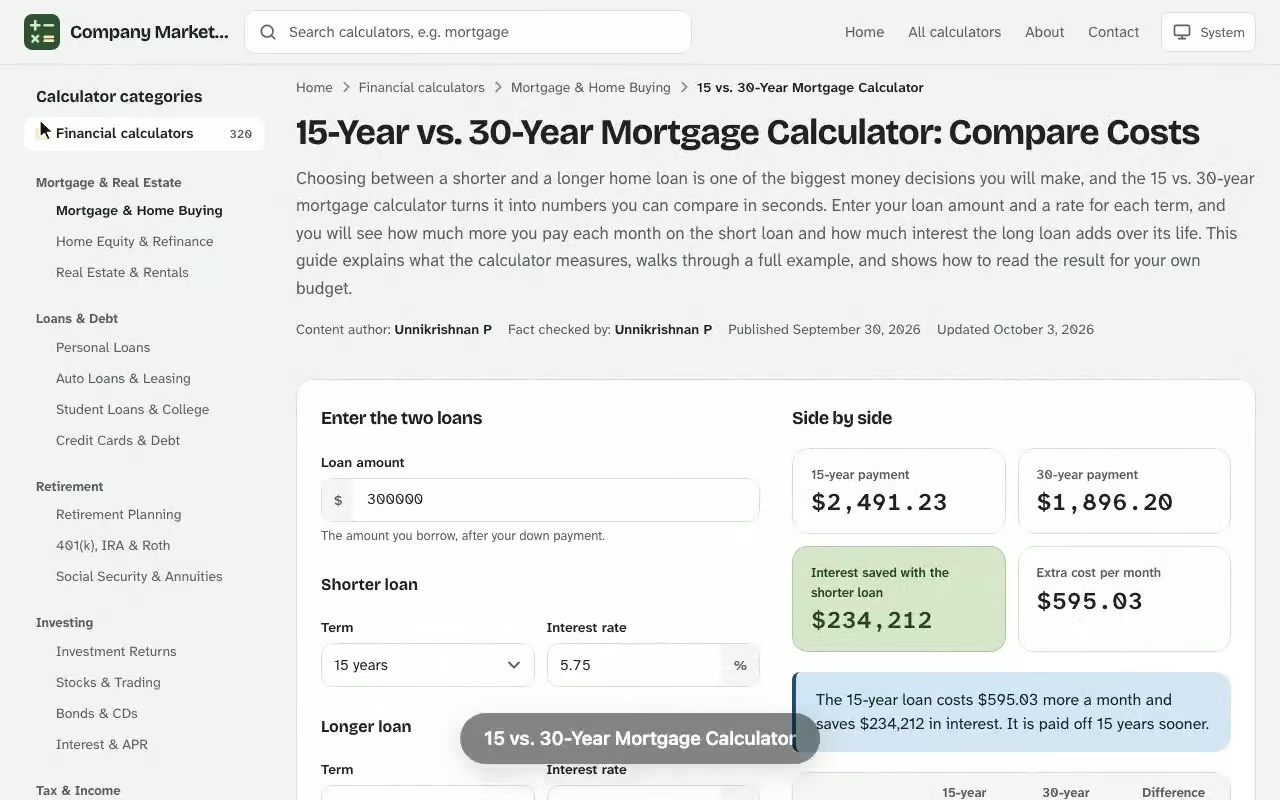
15 vs. 30-Year Mortgage Calculator. Choosing between a shorter and a longer home loan is one of the biggest money decisions you will make, and the 15 vs. 30-year mortgage calculator turns it into numbers you can compare in seconds. Enter your loan amount and a rate for each term, and you will see how much more you pay each month on the short loan and how much interest the long loan adds over its life. This guide explains what the calculator measures, walks through a full example, and shows how to read the result for your own budget. Next, open the free amortization calculator and enter your own details to see an estimate in seconds.
Side by side
Shorter loan payment
–
Longer loan payment
–
Interest saved with the shorter loan
–
Extra cost per month
–
–
Shorter
Longer
Difference
Equity built year by year
Equity here is the loan principal you have paid off. It leaves out your down payment and any change in the home's value.
Year
Shorter: balance
Shorter: equity
Longer: balance
Longer: equity
Equity gap
Results are estimates for educational purposes and are not financial, tax or legal advice.
Using the 15 vs. 30-Year Mortgage Calculator
The 15 vs. 30-year mortgage calculator compares two fixed-rate mortgage options on the same borrowed amount, so the only things that change are the term and the interest rate. A fixed-rate structure also keeps the comparison honest, because neither payment can drift after closing. Gather these numbers before you start: The free mortgage points calculator uses the same plain-English approach, so you can compare results side by side.
Loan amount: the home price minus your down payment.
Interest rate for each term: lenders usually quote a lower rate on the shorter loan, and your credit profile moves both quotes, so enter two different rates rather than one.
Loan term: 15 years on one side and 30 years on the other, though you can change either to test other terms.
Marginal tax rate: your combined federal and state rate, used to estimate what the mortgage interest deduction could save you.
Click the calculate button and you get the monthly payments for each loan, the total of all payments, and the total interest paid over the life of the loan. Everything shown covers principal and interest only. Your real mortgage payment and other monthly outgoings will also include property taxes and homeowners insurance, so treat the output as the core of your housing cost, not the whole of it.
What each result tells you
Before the numbers, remember the goal: a loan that is truly affordable today and still sensible when you look back on it.
The monthly payment answers whether you can carry the loan today. The total interest answers what the loan costs you for borrowing the money. Looking at both together is the whole point of a mortgage comparison: the cheaper loan per month is almost never the cheaper loan overall.
How the 15-Year vs. 30-Year Mortgage Comparison Works
Both loans use the same standard amortization formula. Each month you pay a fixed amount that covers that month's interest first, with whatever remains reducing your principal balance. Pair this with the interest only mortgage calculator online for a fuller picture before you make a decision.
The monthly payment formula
The fixed monthly payment on a loan of \(P\) dollars at a monthly rate \(i\) over \(n\) payments is:
$$M = P \times \frac{i\,(1+i)^{n}}{(1+i)^{n} - 1}$$
Here \(i\) is the annual rate divided by 12, and \(n\) is the term in years multiplied by 12, so a 15-year term has \(n = 180\) and a 30-year term has \(n = 360\).
Total interest and total payments
Once you have \(M\), the total payments are the payment times the number of months, and the total interest is whatever is left after you subtract the amount you borrowed:
$$\text{Total interest} = (M \times n) - P$$
Because the 30-year loan has twice as many payments and usually a higher rate, the interest line grows much faster than the payment line shrinks. That is why a lower payment can hide a far larger bill, since you pay more interest for every extra year.
Reading the amortization schedule
An amortization schedule lists every monthly payment and splits it into interest and principal. Early rows are mostly interest and later rows are mostly principal, which is why both loans pay off slowly at first and quickly at the end. On the example loans, the 15-year schedule has cut the balance to $148,881 by year 10 while the 30-year schedule still shows $291,518, and the calculator's schedule button prints both side by side so you can see the exact month either balance crosses a milestone you care about.
Worked Example: A $342,800 Home Loan Over 15 and 30 Years
Suppose you are borrowing $342,800 after your down payment. A lender quotes 5.875% on a 15-year fixed loan and 6.625% on a 30-year fixed loan. The calculator returns:
Result
15-year loan at 5.875%
30-year loan at 6.625%
Monthly payment (principal and interest)
$2,869.64
$2,194.99
Total payments
$516,535.60
$790,194.95
Total interest
$173,735.60
$447,394.95
Balance remaining after 10 years
$148,881
$291,518
The monthly payment gap
The shorter loan asks for $674.65 more every month, about 31% above the 30-year payment. That is the price of finishing in half the time, and it is the number to hold up against your budget before anything else.
Interest paid over the life of the loan
The longer loan costs $273,659.35 more in interest. In other words, the extra $674.65 a month buys you roughly a quarter of a million dollars of savings, which works out to a strong return when you consider that you also own the home outright 15 years earlier.
The same $342,800 loan costs $273,659 more in interest over 30 years than over 15.
What a 15-Year Mortgage Means for Your Home Equity
A 15-year mortgage pushes more of every payment toward principal, so you build equity much faster. After ten years in the example above, you would owe $148,881 on the 15-year loan against $291,518 on the 30-year loan, a gap of $142,637 in home equity before the house itself gains a cent in value.
Build equity faster, pay less interest
Lenders carry less risk on a shorter term, so the 15-year fixed rate is typically lower, and a shorter schedule means you pay less interest on every dollar borrowed. Equity matters if you plan to refinance, borrow against the home, or sell, since it is the cash you walk away with.
The cost: a tighter home budget
The higher payment raises your debt-to-income ratio, which can lower the amount a lender will let you borrow and make it harder to qualify. It also leaves less cushion for repairs, a job gap or a change in income. A 15-year loan is a commitment you can only leave by selling, refinancing or defaulting, so be honest about your cash flow before you choose it.
Why a 30-Year Fixed Mortgage Keeps Payments Lower
A 30-year mortgage spreads the same balance over 360 payments, which is why it dominates the market among home buyers. In the example, the monthly payment falls to $2,194.99, and that room in your budget has real uses.
Lower payment and flexibility
You qualify for a larger loan because the payment fits more comfortably under your income, and you can still behave like a 15-year borrower by making extra payments whenever cash allows. If money gets tight, you fall back to the smaller required payment. That flexibility is the main selling point of the 30-year term.
The mortgage interest deduction
If you itemize, mortgage interest can reduce your taxable income, and the deduction is largest in the early years when most of each payment is interest. In the example, the first year of the 30-year loan carries about $22,598 of interest and only $3,742 of principal, which is why your marginal tax rate input matters. Still, paying a dollar of interest to save a fraction of a dollar in tax is rarely a good trade by itself.
In year 1 of the 30-year loan, $22,598 of your payments is interest and $3,742 is principal.
The danger of overborrowing
A low payment can tempt you toward a bigger house than you need. Property tax, insurance and upkeep scale with the price, so qualifying for more does not mean you can afford it. Enter the same home price on both terms and you can see how much extra house the lower 30-year payment tempts you toward. Use that gap as breathing room, not as a reason to stretch.
A 15-Year Fixed or 30-Year Fixed Loan on an $8,400 Monthly Income
Marisol earns $8,400 a month before tax and is buying a condo with a $287,350 loan. Her lender quotes 6.125% for 15 years and 6.875% for 30 years, and her property tax and insurance run $410 a month. She wants to know which term stays inside the 28% front-end guideline many conventional lenders use, a ceiling of $2,352 a month for housing.
She enters the loan amount and both rates into the 15-year vs. 30-year mortgage calculator and clicks calculate. The result for principal and interest comes back as $2,444.27 on the 15-year loan and $1,887.68 on the 30-year loan. Adding her $410 puts the full housing cost at $2,854.27 and $2,297.68.
Term
Housing cost
Share of income
Total interest
15 years at 6.125%
$2,854.27
34.0%
$152,618.76
30 years at 6.875%
$2,297.68
27.4%
$392,216.58
The shorter loan lands at 34.0% of income, well above the 28% line, so it fails the lender's test even though it would save $239,597.82 in interest. The 30-year loan lands at 27.4% and passes, which settles which loan she can actually be approved for.
Her next move is a rerun with one input changed. She adds $250 a month in extra principal to the 30-year loan, and the schedule shows the balance reaching zero in 258 months instead of 360, with total interest falling to $262,787.82. That is $129,428.76 less interest than the plain 30-year path, and she can still drop back to $1,887.68 in any month her budget tightens.
Interest Rates and Mortgage Rates: Why Shorter Terms Cost Less
Rates move the answer more than most borrowers expect. A lower interest rate on the shorter term is the second reason it saves so much, and a small change in the interest rate shifts the 15-year payment noticeably, and the shorter the term, the less that rate has time to compound against you. The graphic below shows how the 15-year payment moves across a few rates and loan sizes.
See how the 15 vs. 30-Year Mortgage Calculator works: change the inputs and the interest saved with the shorter loan updates instantly. Enter your own numbers in the calculator above.A half-point change in rate moves the 15-year payment by about $90 a month on $342,800.
Compare the mortgage rates offered for each term, because the spread between the two decides how much the shorter loan saves.
Ask each lender for the annual percentage rate (APR), which folds in the origination fee and points, so you compare full cost and not just the headline rate.
Check closing costs, since a lower rate bought with points only pays off if you keep the loan long enough.
If you put less than 20% down, add private mortgage insurance to both scenarios before you compare.
Invest the Difference or Pay Down the Loan? A Fixed-Rate Mortgage Term Comparison
The monthly gap the calculator reports, $674.65 in the example, is cash you can either invest or send to your loan. A lower monthly payment frees cash for investments, while a higher monthly payment locks that cash into your home instead. Neither choice is automatically smarter. Over decades, inflation shrinks the real weight of a fixed mortgage payment, which favors the longer loan: your $2,194.99 stays the same while prices and wages tend to climb. Over the same decades, the shorter loan turns every extra dollar into ownership of real estate you hold free and clear, and that kind of homeownership is a steady way to build wealth.
Fixed-rate loans versus adjustable-rate loans
The calculator assumes a fixed rate for both terms, so each payment stays put. An adjustable-rate loan can start with lower interest rates yet reset to higher interest rates, a risk this comparison does not model. That certainty lets you pay off a known balance on a known schedule.
The tax deduction and your tax bracket
Enter your combined tax rate and the calculator estimates the tax deduction from mortgage interest on each loan. Treat it as a bonus: stretching the loan means you pay more interest, and the savings on your tax bill return only a fraction of that extra cost, so weigh the gap between the two monthly payments against what you could earn by investing it.
Choosing a Mortgage Term: Questions to Ask Yourself
The calculator gives you the math, and a few honest questions give you the decision. Work through them in order.
Could you comfortably afford the 15-year payment while still saving for retirement and an emergency fund?
Would you actually invest the monthly difference, or would it be absorbed by everyday spending? A disciplined investor can sometimes beat the mortgage rate in a tax-advantaged account, but a stock market downturn can erase that edge.
Do you expect to stay in the house long enough for the interest savings to matter, or might you refinance within a few years?
Is your income stable enough to lock in the higher payment?
Treat the 15- vs. 30-year mortgage calculator as a way to test each answer with real figures. If your answers point both ways, a common middle path is the 30-year term with a habit of paying extra toward principal, which keeps the flexibility while shaving years off the payoff.
Which Is Better: A 15-Year Fixed or a 30-Year Fixed Loan?
There is no universal winner. The 15-year fixed option costs less in total and builds ownership fast, and the 30-year fixed option costs more overall but protects your monthly cash flow. Run your own figures through the 15-year vs. 30-year mortgage calculator, compare the payment against your budget and the interest against your goals, and pick the term whose trade-off you can live with for the life of the loan.
15 vs. 30-Year Mortgage Calculator questions
Is a 15-year or 30-year mortgage better?
Neither wins for everyone. A 15-year loan costs far less in interest and builds equity faster, while a 30-year loan keeps the monthly payment lower and your budget more flexible. Enter both rates and compare the payment with what you can comfortably afford.
How much interest does a 15-year mortgage save?
Usually a large amount, because you borrow for half as many years and lenders typically charge a lower rate on the shorter term. The calculator shows the exact interest saved for your loan amount and rates.
Why is the 15-year monthly payment higher?
The same balance is repaid in 180 payments instead of 360, so each payment carries more principal. The payment is often around 30% higher than on the longer loan.
Can I pay off a 30-year mortgage early?
Yes. Most fixed-rate loans let you make extra principal payments. That shortens the term and cuts interest while keeping the lower required payment as a safety net. Check your loan for prepayment penalties first.
Does the calculator include taxes and insurance?
Yes. Property taxes, homeowner insurance, PMI and HOA fees are added to principal and interest to give an all-in monthly payment, and each is shown separately.
When is PMI required?
Lenders typically require private mortgage insurance when your down payment is under 20% of the home price. The calculator adds PMI only in that case.
Do shorter loans get lower interest rates?
Typically yes, since the lender is exposed to risk for fewer years. The gap changes over time, so enter the actual rate quoted for each term.
Is mortgage interest tax deductible?
If you itemize deductions, mortgage interest on a qualifying home loan can reduce your taxable income. The tax savings result is an estimate based on your marginal tax rate; confirm details with a tax professional.